
A welcome package should prepare a new franchisee to represent the brand from day one, not leave them sorting through disconnected materials. A practical plan for new franchisee welcome package printing starts with the essentials: business cards, brochures or flyers, and branded displays or banners, selected to match the location’s launch needs. The right mix depends on what the franchisee must communicate, where they’ll use each item, and the brand standards they need to follow.
It’s reasonable to want a clear view of per-location costs and timing before production begins. Pricing depends on package contents, quantities, print formats, and finishing. The schedule depends on artwork readiness, approvals, production, and delivery. Using consistent templates across locations helps keep materials aligned while tailoring each kit to its intended use.
This guide covers which printed materials and kit items to consider, what affects per-location pricing, and how to plan production. It also explains how a print partner can coordinate cohesive collateral, from paper materials to event displays, for a polished franchise launch.
Key Takeaways
- Build each welcome package around the franchisee’s launch needs, combining practical printed materials with relevant training and territory information.
- Use consistent brand templates for location collateral, then select formats that suit the franchisee’s outreach and display needs.
- Plan per-location costs around the package contents, quantities, print formats, and finishing rather than assuming every location needs the same kit.
- Production timing depends on artwork readiness, approvals, production, and delivery, so include these stages in the launch schedule.
- Consider how different locations may need different quantities, such as a small location ordering 2 kits while a flagship location orders 25.
Custom welcome packages for new franchise locations
A useful welcome package connects a franchisee’s opening tasks with the franchisor’s brand system. Group materials by purpose: onboarding, territory planning, customer outreach, and in-location promotion. A package might include stationery, territory maps, marketing materials, and uniforms. Printed pieces should complement training and operational information, not replace it.
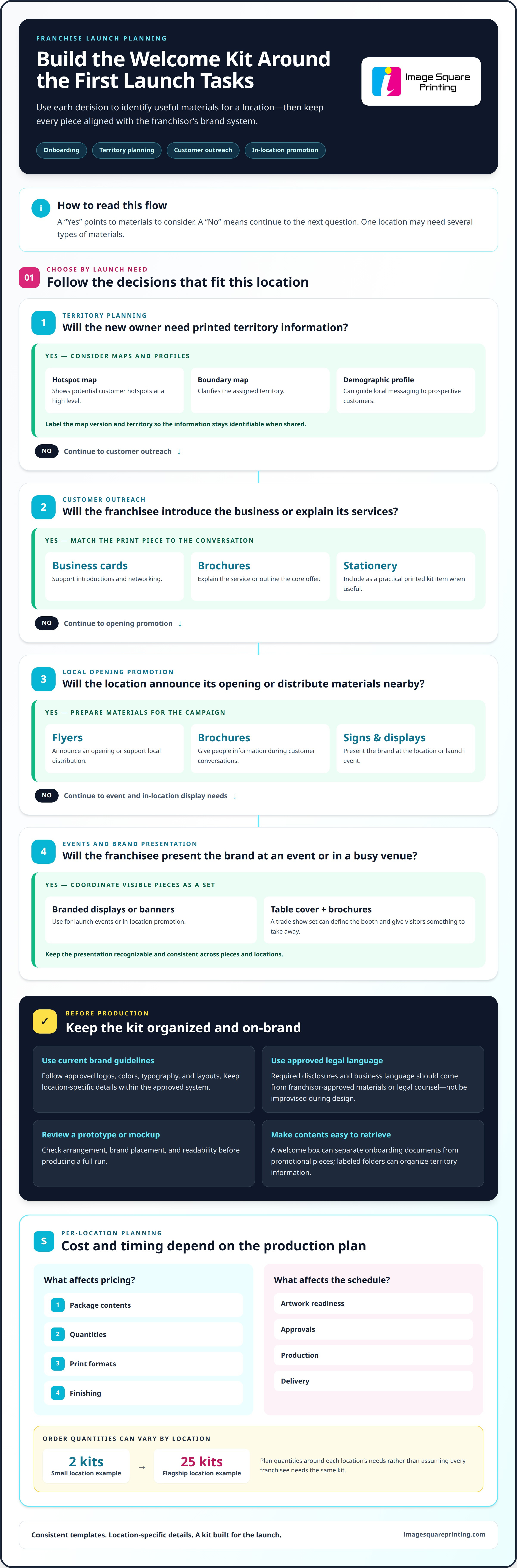
Territory maps can help a new owner understand where the location fits and whom it serves. A package might include a high-level map of potential customer hotspots, a detailed territory boundary map, and a demographic profile of prospective customers. Each supports a different decision: the boundary map clarifies the assigned area, while demographic information can guide local messaging. Label the map version and territory clearly so the information remains identifiable when shared.
Print options include business cards, brochures, flyers, stationery, maps, and display materials. Choose formats based on the franchisee’s first tasks, such as networking, explaining services, or presenting the brand at a launch event.
Custom packaging helps organize the kit, but the contents should drive the format. A welcome box can separate printed onboarding documents from promotional pieces, while labeled folders keep territory information easy to retrieve. Before producing a full run, prepare a prototype or visual mockup to review the arrangement, brand placement, and readability. A mockup can also show how the package coordinates with a life-size cutout display at an opening event.
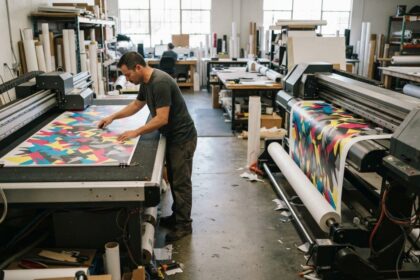
Print production for franchise onboarding calls for repeatable materials alongside location-specific versions. Look for a workflow that keeps core branding consistent while accommodating approved details such as the franchisee’s name, territory, or location information.
An online print portal can centralize approved files and simplify repeat ordering across locations. A local print shop can provide direct coordination around a particular package or launch schedule; the right workflow depends on how much customization and production guidance the franchisor needs.
Use the franchisor’s current brand guidelines for logos, colors, typography, and approved layouts. Legal disclosures and required business language should come from the franchisor’s approved materials or legal counsel, not be improvised during design. Keeping these details in the source files helps prevent inconsistencies across franchise locations.
SunDance says franchise signage should be clear and consistent across locations and mediums. This is a useful standard when choosing signs and other branded pieces for a new location: the presentation should remain recognizable across the franchise. Welcome package choices can reflect local needs while staying consistent with the franchisor’s brand system. Welcome package choices can reflect that local adaptation while keeping signage aligned with the franchisor’s brand system.
Franchise marketing print collateral
Franchise marketing materials should turn a central brand message into clear local communication. For a new location, brochures can explain the service, flyers can announce an opening, and business cards can support introductions. Match each piece to a specific audience and action. A neighborhood flyer might invite readers to a launch event, while a brochure can outline the franchise’s core offer.
Before production, organize collateral by campaign and intended use. A practical set might include brochures for customer conversations, flyers for local distribution, and signs or displays for events. Keep approved logos, colors, and messaging consistent across formats. Then adapt permitted details, such as location information or opening announcements, to make each piece relevant without changing the franchise’s identity.
Pre-launch promotion can combine print with local channels. A campaign might pair flyers with local public relations, local press advertising, a location webpage, Google AdWords, or radio promotions. Give each channel a distinct role: printed flyers can introduce the opening nearby, while a webpage can provide fuller details. Align the campaign calendar with when materials will be ready and where they will be distributed.
Ongoing marketing needs fresh reasons for customers to notice the location after opening. Plan collateral around seasonal offers, community events, and new services, using the franchisor’s approved templates where available. A franchise network may use a centralized storefront and templates to reduce one-off designs and support consistent branding. Keep a record of approved versions, location-specific edits, and the campaign each file supports.
Trade shows call for materials that remain visible in a busy venue and work together as a set. A branded table cover can define the booth, while brochures give visitors something useful to take away. Coordinated trade show display materials can carry the same message across the booth. Plan the display around the audience and event purpose, not simply the amount of space available.
Common printing and fulfillment mistakes include using outdated artwork, mixing inconsistent versions, and sending the wrong materials to a location. Prevent them with a final file review, clear location labels, and a packing list for each franchise order. Match print quantities to the campaign plan so collateral is ready for its intended distribution, rather than arriving after launch.
Outreach may call for different formats for different audiences. The U.S. Environmental Protection Agency identifies bin tags, bill inserts, and brochures as possible outreach materials, with multilingual materials used when needed. The same principle applies to franchise campaigns: choose a format and language that make the message accessible to the intended community.
Franchisee start-up kit contents
A franchise start-up kit brings onboarding materials together in one organized package. It can include corporate training materials, human resource packets, business cards, brochures, and tri-fold displays. Printed pieces should help a new owner move from learning the operating model to communicating with customers. Separate training references from public-facing collateral so each item has a clear purpose.
Training materials support consistent procedures across locations. An operations manual may be provided in written, video, and audio formats, giving franchisees different ways to access instructions. A franchisor may allow a prospective franchisee to review the manual during due diligence, then formally provide it when training begins. Printed quick-reference pages can help orient staff, while the full manual remains the source for detailed procedures.
Human resource packets meet a different onboarding need. They can gather employment forms, role descriptions, and internal information selected by the franchisor. Organize the packet with introductory guidance first, followed by forms grouped by purpose. Keep business-facing pieces separate so customers’ materials aren’t mistaken for internal documents.
A kit can also prepare the franchisee for early conversations with customers and suppliers. Consider how each item supports a specific task:
- Business cards: Provide a portable way to share the franchisee’s name and business details during introductions.
- Brochures: Give prospective customers a concise overview of the franchise’s services or products.
- Tri-fold displays: Present key information in a compact format for meetings or local events.
- Supplier introductions: Connect the franchisee with approved sources and explain purchasing processes.
Supplier introductions and pre-negotiated discounts may be part of a start-up package. Put these details in a clearly labeled section, apart from public marketing pieces. This helps the owner find operational contacts quickly and avoid distributing internal information during customer outreach.
Packaging should make the kit easy to navigate from the moment it is opened. Use labeled folders or dividers for training, human resources, supplier information, and customer collateral. A contents sheet can name each section and identify materials intended for staff or customers. This simple structure makes a physical kit more useful during training and helps a franchisee find the right document as opening tasks progress.
For new franchisee welcome package printing, organize the kit around the franchisee’s first responsibilities. The franchisor defines the approved content, while print production keeps customer-facing pieces legible and consistent. Review the contents as one system, clearly separating internal guidance from materials that represent the brand publicly.
Per-location kit pricing and production timelines
Kit costs are best planned by location, because package contents and quantities can differ. A small franchise location can order 2 kits while a flagship location orders 25 kits from the same store. That difference affects the quantity of each printed piece and how kits are assembled. A consistent brand template can keep the design aligned while each location receives the materials it needs.
Per-location printing prices depend on package contents, quantities, print formats, finishing, and delivery. Image Square Printing provides pricing through a quote or corporate account. To make the quote useful, define kit contents and quantities by location. Separate shared materials from items requiring location-specific details, such as the franchisee’s contact information. This clarifies where orders differ and which components can use the same approved artwork.
Ask for costs to be organized by package component, rather than presented as one unexplained total. A clear breakdown can distinguish printed pieces, customized versions, finishing, assembly, and delivery. It also shows how a change affects the package. For example, adding another brochure version can affect artwork preparation and quantities, while changing the kit count affects the production run.
Production timing depends on artwork readiness, approvals, printing, assembly, and delivery. Treat these as connected steps in the launch schedule. Final artwork must be ready before production begins, and location details need approval before customized pieces are printed. If a component changes after approval, allow for revised files and another review.
Build the schedule backward from the date each location needs its kit. Set the required delivery date first, then allow time for file preparation, review, printing, finishing, packing, and shipping. Clarify who approves each step, especially when franchise marketing teams approve brand use and local teams supply location details. Consolidating feedback before production can reduce avoidable revision cycles.
For multiple locations, use a production matrix that lists each kit, destination, quantity, and approved version. Mark shared components separately from location-specific pieces. The 2-kit and 25-kit example can guide this comparison: the smaller order may need fewer pieces, while the flagship order may require a larger run. Both still need accurate packing and destination labels.
Before release, match the final packing list to each location’s approved order. Confirm the correct versions and quantities, and schedule delivery around the opening plan. This final handoff connects the quote, artwork approvals, and fulfillment details in one location-by-location plan.
Kit item selection
Choose each kit item for a defined task, not simply to make the package feel substantial. A promotional kit could pair presentation folders with flyers, tri-fold brochures, letterhead, and car magnets. A networking kit could combine business cards, postcards, thank-you cards, banners, and printed tablecloths or table throws. Each combination supports different activities, so let the franchisee’s immediate priorities guide the selection.
For customer presentations, folders can hold brochures, service information, and location-specific inserts. Tri-fold brochures offer a compact way to explain an offer, while flyers can announce a launch or local promotion. Letterhead supports formal business correspondence. Select pieces that work together visually and keep the franchise’s approved identity consistent across formats.
Networking materials should help franchisees introduce the business and continue conversations afterward. Business cards provide contact details, postcards can carry a follow-up message, and thank-you cards can support relationship-building after an event. A banner and printed table cover can make the franchise visible at a community gathering or trade show. For a booth, coordinate the tabletop presentation and takeaways to create a unified identity.
Car magnets suit situations where a franchisee wants branded visibility while traveling between local appointments. They serve a different purpose from presentation materials, so include them only when mobile outreach fits the location’s marketing plan. A banner, similarly, may be more useful for public events than routine customer meetings. Match each item to an actual distribution or display setting.
Use this selection sequence to keep the kit focused:
- Define the task: Identify whether the franchisee needs to present, distribute, display, or follow up.
- Assign a format: Pair presentations with folders and brochures, outreach with flyers or postcards, and events with banners and table covers.
- Check the audience: Choose language and content suited to the people receiving each item.
- Separate shared and local details: Keep core brand artwork consistent while preparing approved location-specific information.
Quantity affects usefulness, too. Business cards and flyers for broad distribution may call for different quantities than a banner for a single event. For each location, group items by purpose and note where they will be used. This helps prevent duplicate items that serve the same task while making it easier to spot practical gaps, such as materials for post-event follow-up.
A polished event kit can include coordinated printed table covers for franchise events, banners, and take-home materials. Select items around the franchisee’s actual launch and networking activities, then keep the final mix easy to distribute and replenish. The result is a purposeful package, with each printed piece supporting a clear moment in the customer journey.
Image Square Printing
Image Square Printing produces coordinated visual materials for new-location launches. Bring together approved brand artwork, location details, intended uses, and a delivery plan to shape a print-ready project. This can be useful when a package needs printed elements for both the franchisee’s workspace and a public opening.
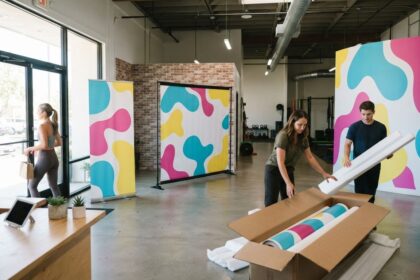
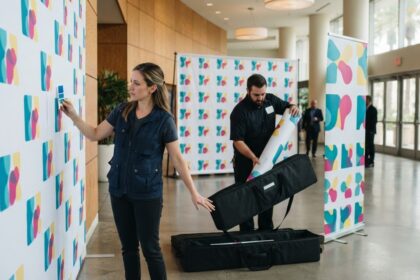
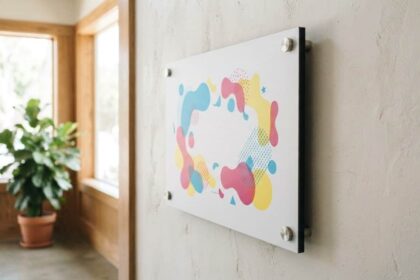
For example, custom wall covering can carry the brand into a location, while a step and repeat backdrop can create a consistent event setting. Retractable banner stands can support presentations or launch activities. Choosing formats around the location’s actual needs helps keep the visual package focused and cohesive.
Share your planned materials and schedule with Image Square Printing to align the visual components with your franchise launch. Contact Image Square Printing to discuss your project.
Prepare the Next Location with Confidence
Treat new franchisee welcome package printing as a repeatable part of opening a location, not a one-time handoff. A well-planned visual system can support future launches while giving each franchisee materials suited to their space and customer interactions. As locations develop, review whether the package still serves its purpose and whether the brand presentation remains coherent across print and in-store graphics.
Image Square Printing produces visual materials including Retractable Banner Stands, custom wallpaper printing, and custom wall covering. These formats can help extend a franchise’s identity from launch events into its physical environment. Share your project goals and planned applications to start shaping a cohesive package for your locations. Contact Image Square Printing to discuss your franchise printing needs, and take the next step toward a polished launch.
Frequently Asked Questions
What should a new franchisee welcome package include?
Include materials the franchisee needs to begin operating and communicating under the brand. A practical package can combine onboarding references, staff information, approved customer-facing collateral, and key supplier contacts. Add a contents guide that distinguishes internal documents from items intended for customers. A new owner should be able to identify which materials support staff orientation and which are appropriate to distribute during an opening promotion.
How much does it cost to print franchisee welcome kits?
Printing costs depend on kit contents, quantities, materials, dimensions, finishing, artwork preparation, and fulfillment requirements. Image Square Printing provides pricing through a quote or corporate account, rather than a fixed universal kit rate. A quote can reflect differences such as a standard printed insert versus a customized piece for each location. Consolidating approved package specifications helps clarify the project scope before production begins.
What are typical quantities and turnaround times for welcome package printing?
Kit quantities should reflect each location’s onboarding and outreach needs; there is no single quantity that suits every franchise. A location opening with several new staff members may need different contents or quantities from one preparing mainly for customer outreach. Turnaround depends on artwork readiness, approval, production, finishing, packing, and delivery. Account for customized files and destination requirements alongside the opening date.
How do franchise brands customize welcome kits for each location?
Brands typically preserve a shared visual system while customizing approved details for each location. A master design can retain consistent logos, colors, and messaging, while location versions update details such as the franchisee’s contact information or local address. Keep a controlled record of approved files and version names. This helps distinguish current location-specific materials from shared artwork when the franchise adds or updates a site.
Which print vendors specialize in franchise onboarding kits?
Print production for franchise onboarding can support both repeatable materials and location-specific versions while keeping core branding consistent.