
A logo is only one part of a brand’s visual identity. Graphic design combines color, typography, imagery, and layout to create consistent materials, from business cards and brochures to signs and event displays. The benefits of professional graphic design services include a more cohesive brand, a polished business image, and visual materials tailored to your goals.
It’s easy to see why businesses want professional-looking designs. But strong graphic design does more than make one item attractive: it helps brand materials work together and presents your business clearly across print and display formats.
This article explains what graphic design is and how professional design supports brand consistency, credibility, and customized marketing materials. You’ll also learn how design can connect logos, business cards, signs, and other visuals into a unified presence, and how a print and graphics partner can help bring that vision to life.
Key Takeaways
- Consistent typography, colors, and layouts help your brand feel recognizable across different materials.
- Polished visuals can make your business’s presentation better reflect the quality of its work.
- Custom design can adapt visual materials to your message, audience, and intended use.
- Designing print and display pieces as a coordinated set helps create a more unified brand presence.
- Professional design support can be useful when a project needs cohesive visuals across multiple formats.
Brand consistency in formatting, style, fonts, and colors
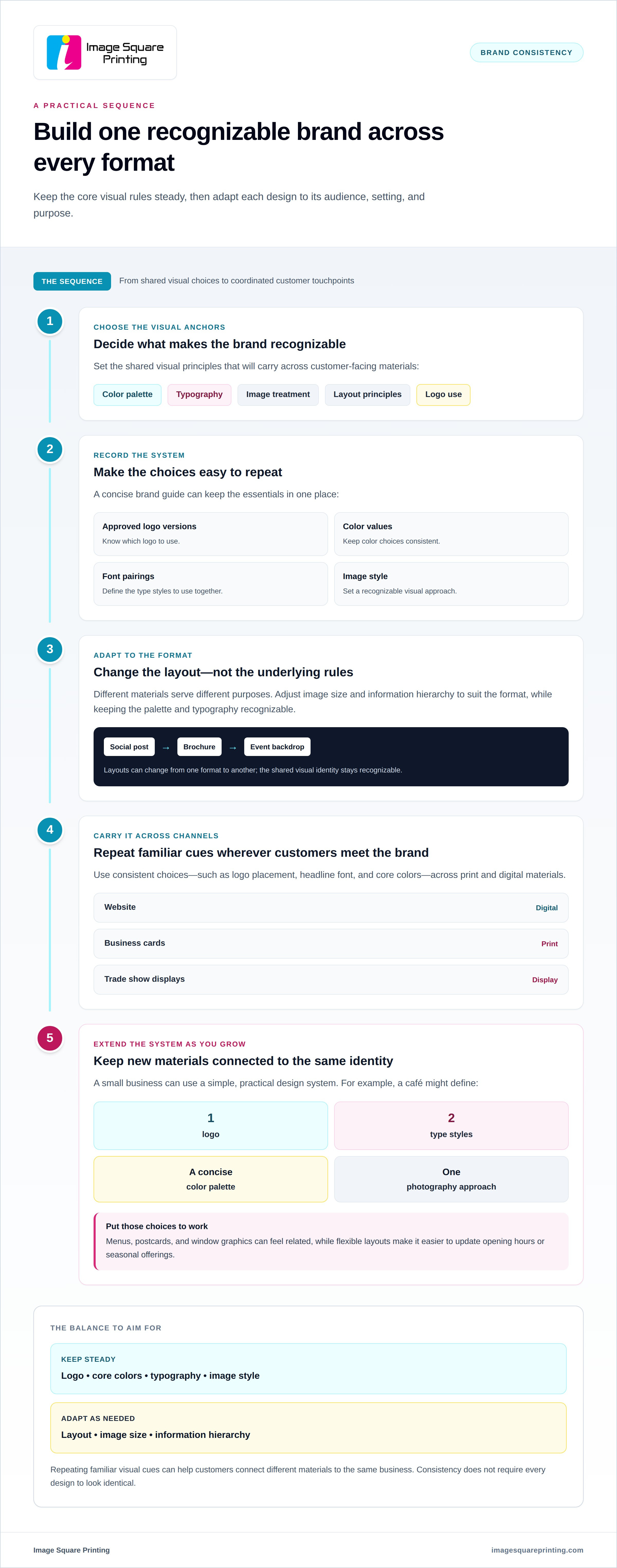
Brand consistency means applying the same visual principles across customer-facing materials. A shared color palette, type style, image treatment, and layout help customers recognize your business in different settings.
Consistent Branding Across Platforms
Consistent branding carries a business’s visual identity from printed materials to digital platforms. For example, a company can use the same logo placement, headline font, and core colors on its website, business cards, and trade show displays. That continuity helps a customer connect each interaction to the same business. A concise brand guide can record those choices, including approved logo versions, color values, font pairings, and image style.
Consistency doesn’t mean every design must look identical. A social post, brochure, and event backdrop serve different purposes, so their layouts can change while their underlying visual rules remain stable. A designer can adjust image size and information hierarchy for each format, while keeping the same palette and typography. This gives the audience a recognizable thread without forcing every material into one template.
Small businesses can benefit from a simple, practical design system rather than a complex brand manual. A café, for instance, might define one logo, two type styles, a concise color palette, and a photography approach. Those choices help staff create menus, postcards, and window graphics that feel related. Flexible layouts also make it easier to update opening hours or seasonal offerings without creating a visual mismatch.
Consistency, Trust, and Recognition
Brand consistency supports recognition by repeating familiar visual cues, which can help customers feel more confident about a business. When they see the same logo and color treatment on a sign, brochure, and event display, the materials reinforce one identity. By contrast, clashing fonts or unrelated imagery can make a business seem disconnected, even if each design looks polished on its own.
Sustainability, AI, and localized branding all call for deliberate visual decisions. Reusable layouts can reduce the need to rebuild materials for each campaign, while planning print quantities around actual uses helps avoid unnecessary output. AI tools may help explore visual directions, but colors, imagery, and final messaging still need human review for consistency and context. For businesses serving distinct audiences, localized photos or references can connect with them while preserving the core logo and design system.
Consistency becomes especially useful as a growing business adds materials and channels. A designer can document the core visual choices, then adapt them to each format without losing recognition. The result is a clearer identity across customer touchpoints, from an introductory postcard to an event display.
Matching a business’s visual appearance to its professionalism
A business’s visual presentation should reflect the quality of its actual work. Graphic design connects the message, audience, and visual elements so each interaction feels deliberate.
Visual Professionalism and First Impressions
Visual professionalism means using clear, polished design to make a business’s presentation reflect its standards. That matters because a first impression can influence whether someone considers the business credible. A well-organized service brochure, for example, can present offerings and contact details more clearly than a crowded page with competing type styles.
The human brain can take in and decode an image in 13 milliseconds. That makes the visual choices on a sign, website, or postcard an early part of how people experience a brand. According to Adobe, 48% of consumers base a company’s credibility on its website design. Hiring a designer can help align a site’s imagery, spacing, and typography with the level of professionalism customers should expect.
Graphic Design as Visual Communication
Graphic design is visual communication: it arranges images, color, type, and space to make information easier to understand. This matters when a customer must identify a service, understand an offer, or find a next step quickly. A promotional postcard, for example, can give the main offer visual priority, then place supporting details and contact information in a clear reading order.
Visual content is processed 60,000 times faster than text. A strong layout can therefore help someone grasp the central idea before reading every detail. Designers use contrast, alignment, and whitespace to separate key elements, while matching imagery to the audience and message. These choices support attention and information retention without making a design feel crowded.
Digital marketing also depends on visuals that fit the campaign’s purpose. A social post announcing a new service needs a clear message and an image that supports it; a landing page may need a more detailed explanation and a visible action. Consistent campaign visuals help people connect those touchpoints, while tailored layouts let each format work naturally. For a physical promotion, floor and wall graphics can carry campaign visuals into a business space.
Graphic design also helps match tone to audience. A professional services firm may use restrained colors, precise spacing, and direct imagery, while a family event may call for warmer colors and more expressive visuals. Neither approach is automatically more professional. The right choice depends on the brand, audience, and setting. A designer balances those factors so the visual message feels intentional rather than generic.
For a digital campaign, designers can adapt the same core message across an advertisement, social post, and landing page. They adjust hierarchy and image cropping for each format while keeping the central idea recognizable. That coordination is one practical benefit of professional graphic design services: visual marketing can look polished and direct attention to the information that matters.
Customized design solutions
Customized design starts with a specific business goal, not a prebuilt template. A bakery might want to promote a seasonal menu; a property firm might need to make listings easier to scan. A designer translates the purpose into choices about format, imagery, hierarchy, and message. The result is tailored to the audience and the moment they encounter it.
Start by defining the assignment: who needs to notice the material, what they should understand, and what action should follow. A launch campaign might need an announcement, product details, and a clear purchase prompt. A designer can organize those priorities into a visual brief, then select a layout and image direction suited to the campaign. Each design choice has a clear purpose.
The format shapes how a message should be presented. A social media graphic appears in a crowded feed, while a printed handout may be read at a counter. The designer adapts text size, image placement, and information density to each setting. A social post, for example, can lead with one compelling benefit, while a longer brochure has room for supporting details. The core idea stays intact, but its presentation suits the format.
Customization helps businesses speak to different audiences without losing their central message. A company serving first-time buyers and experienced customers may need distinct campaign visuals. The first audience might respond to a simple explanation, while the second may need focused product details. A designer can adjust imagery and emphasis for each group, unlike generic materials that treat every reader alike.
Practical constraints also shape the solution. A design for a narrow display area needs a different composition from one viewed on a phone. Before setting the layout, a designer considers viewing distance, available space, image quality, and the amount of copy. If a headline must be readable from across a room, it should stand out more than supporting text. These decisions connect the design to its actual use.
Customization can support a campaign across several channels. A new service announcement, for example, might use a shared concept across a social post, landing page, and printed materials. Each version can emphasize the detail most useful in that setting while retaining related imagery and messaging. This helps audiences recognize the campaign and follow a coherent path from discovery to further information.
Success isn’t measured by visual novelty alone. Design should solve the original communication problem, whether that means clarifying an offer, attracting attention, or making essential details easy to find. A designer can use the brief to assess each choice: does the headline serve the goal, does the image suit the audience, and is the next step clear? That focus keeps creative decisions purposeful.
Designing logos, business cards, stationery, signs, and websites
A visual identity works across more than one format. A logo, business card, letterhead, sign, and website each serve a different purpose, but coordinated design helps them feel like parts of the same business. A graphic design studio can support both website and print design for a project, aligning its visual direction across customer touchpoints.
A logo needs to remain clear in different settings, from a website header to a small card. Designers consider its shape, spacing, and colors, then prepare versions suited to different backgrounds and sizes. A detailed mark, for example, may need simplification when reduced. This planning helps the logo stay recognizable without forcing every format into the same composition.
Business cards and stationery carry practical details alongside brand identity. A card needs a readable name, role, and contact information, while a letterhead must leave room for correspondence. Designers set a clear order for those elements, then apply matching type and color choices. Businesses that use digital business cards can extend that identity into a shareable format while keeping contact details easy to find.
Signs face different viewing conditions from cards or stationery. A storefront sign may need to attract attention from a distance, while an A-frame sign can guide people near an entrance. The designer considers location, viewing angle, message length, and contrast when arranging the layout. A short headline and visible business name often work better for passing viewers than dense supporting copy.
A website needs to organize information for people with different needs. A potential customer may want to understand a service, view examples, or find contact details. Designers use page structure, typography, imagery, and navigation to make those paths clear. A service page, for example, can present its main offering first, followed by supporting details and a direct next step.
Each item has distinct production and use requirements, so the design process should account for its final format. A logo file for a website differs from artwork prepared for a sign; business card layouts need to preserve readable contact details. A professional can coordinate those assets, reducing the risk of inconsistent colors, stretched marks, or misplaced information across formats.
Before a project begins, the designer clarifies its audience, purpose, required materials, and key message. That brief helps determine whether the business needs a logo refresh, a coordinated stationery set, a new sign, or a connected website and print system. A freelancer or studio can then shape the scope around those priorities. The clearest takeaway: design each item for its use, then connect the pieces through shared identity choices.
How do professional graphic designers compare with freelancers, agencies, and DIY design tools?
The right design support depends on the project’s scope, formats, and workflow. A single promotional graphic differs from a campaign requiring coordinated layouts, copy, photography, and print production. Comparing how each option handles those needs helps clarify where professional design fits, without assuming one approach suits every business.
A freelance designer can provide direct collaboration on a defined assignment, such as refreshing a brochure or creating a social graphic. Working closely with one person can make feedback straightforward, especially when that person owns the design decisions. A larger project may need additional skills. If a campaign involves illustration, copywriting, photography, and print coordination, those capabilities need to be managed as part of the project.
A design studio can draw on multiple designers and networks of specialists, including copywriters, printers, photographers, web developers, and illustrators. That range can help when a brief spans several disciplines. A campaign involving a landing page and printed event materials, for example, may benefit from coordinated input across digital and print work. Studios may also have processes for moving a project from initial requirements through design and production.
An in-house team gives a business ongoing access to designers who work within the organization. This can suit businesses with a steady flow of requests, such as sales presentations, campaign assets, and routine updates. However, experienced in-house design teams generally cost more to hire than a design studio. Studios can spread software and hardware costs across multiple designers, while a larger team may handle more projects than an in-house department.
DIY design tools can help someone assemble a simple, one-off graphic using existing templates. They may suit a quick internal announcement with limited design needs, but the user still has to make decisions about hierarchy, typography, image selection, and adapting the design across formats. A template made for a social post, for example, may not work well as a large sign or detailed brochure. Professional designers bring expertise to those choices and tailor artwork to the project’s purpose.
To choose an approach, first define the deliverables and skills involved. A single, clearly scoped graphic may suit a freelance arrangement. A campaign with multiple formats or specialist requirements may call for a studio’s broader team and established process. An ongoing stream of internal work may make an in-house team relevant. The benefits of professional graphic design services are clearest when the project requires expertise beyond assembling a template.
For a project that combines design with print materials, discuss your graphic design and printing project as a connected brief. A clear outline of the audience, message, formats, and intended use gives the design work a practical starting point.
Image Square Printing
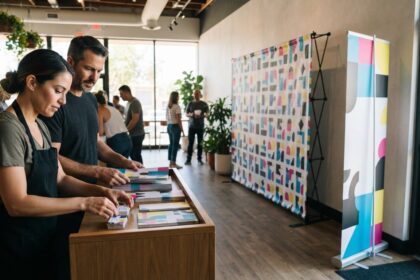
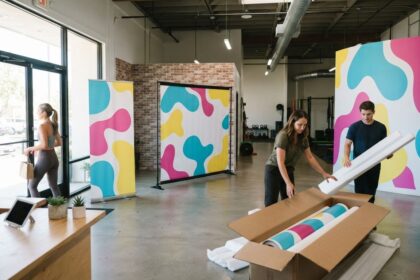
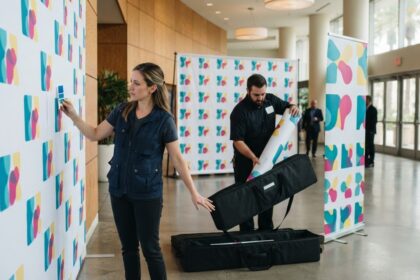
Image Square Printing helps businesses turn brand concepts into custom visual materials for events, promotions, and commercial spaces. Its graphic design and printing services support projects where artwork needs to work across physical formats, from Step and Repeat Backdrops to custom wallpaper and Retractable Banner Stands. This can help when preparing an event, updating a branded space, or bringing campaign visuals into an environment.
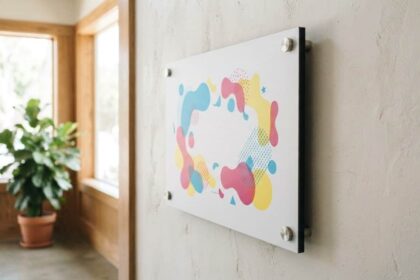
Share the project’s purpose, audience, and intended use to guide the design direction. Image Square Printing can connect those priorities with suitable visual materials, including custom wall covering for branded interiors. Contact Image Square Printing to discuss your graphic design and printing project.
Put Your Brand’s Next Visual Project in Motion
Choose a project that can improve how customers encounter your business, such as an event display or branded interior. The benefits of professional graphic design services become clear when creative decisions support a business goal, from the first concept to the finished material. A focused brief gives the work direction: explain the audience, setting, and impression you want to make.
Image Square Printing can help turn that direction into printed visual materials. Options include Retractable Banner Stands for events, along with custom wallpaper printing and custom wall covering for branded spaces. The right format depends on where people will see the design and what it needs to communicate. Keeping that use in mind helps turn a visual idea into a practical project.
Move your next brand project forward with a clear purpose and a defined visual direction. Contact Image Square Printing today to discuss the materials that fit your goals. A thoughtful design can give your next campaign a polished start.
Frequently Asked Questions
What are the main benefits of hiring a professional graphic designer?
A professional graphic designer brings visual expertise to projects that need more than a quick layout. They can clarify the brief, develop a creative direction, and prepare artwork for its intended use. This is especially useful for a product launch involving several materials, where a poorly coordinated file or unclear message can slow production. The benefits of professional graphic design services include expert oversight from the initial concept through final artwork preparation.
How does professional graphic design improve brand recognition and consistency?
Professional design helps a business apply its brand assets accurately as campaigns change. A marketing team, for example, can provide approved logos, colors, and image files so a designer can create fresh materials without changing core identity elements. This makes new work easier to associate with the business, even when the message or format differs. Clear asset handling also reduces the risk of outdated logos or inconsistent artwork in customer-facing materials.
How can graphic design increase customer trust, engagement, and conversions?
Graphic design can make a customer’s next step easier to understand. A service page, for example, can pair a concise headline with relevant details and a clearly visible contact action. This structure helps visitors find useful information without sorting through competing messages. Strong visuals can attract attention and support engagement, while clear calls to action can encourage conversions. Design can improve the path to action, but it can’t guarantee a sale.
What is the process and timeline for working with a professional graphic designer?
Begin by defining the audience, what they should understand, and what action should follow. The designer then develops a visual brief and selects a layout and image direction suited to the goal and format.
What are the risks of using unlicensed images, fonts, or poorly designed marketing materials?
Clashing fonts or unrelated imagery can make a business seem disconnected, while crowded layouts make information harder to understand. Polished, consistent visuals help a business present itself clearly and credibly.