
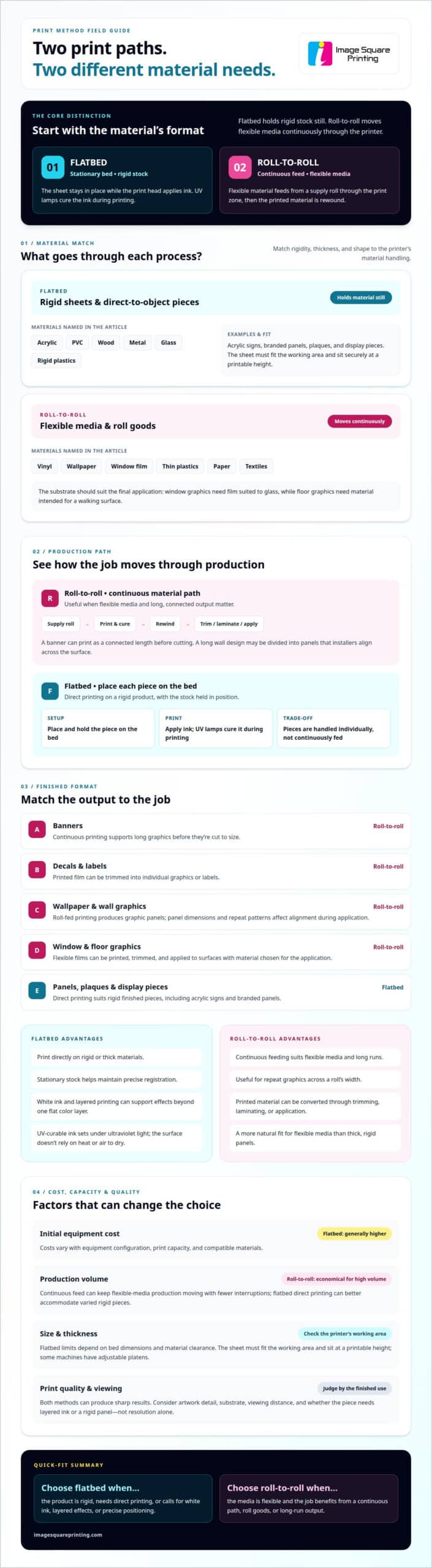
The finished material should guide the process: flatbed printing holds rigid stock on a flat bed, while roll-to-roll printing feeds flexible material continuously through the printer. In flatbed printing vs roll-to-roll, the better fit depends on the product, its finishing needs, and the production volume.
Both methods can produce crisp, high-impact graphics, but they handle materials and production differently. Flatbed printing suits rigid items such as acrylic or PVC signs; roll-to-roll is designed for flexible media such as vinyl, wallpaper, and banners. Compare how each process works, the production volume and finishing required, and the format of the finished piece to choose the right approach.
Key Takeaways
- Match the printing method to the material’s rigidity, thickness, and shape to support a clean, accurate result.
- For flexible media produced in long runs, continuous feeding can help keep production moving with fewer interruptions.
- Factor in finishing early: trimming, laminating, or applying the print can influence which process best suits the final piece.
- When a project calls for white ink, layered effects, or a detailed display piece, a flatbed process may be the stronger fit.
- Compare print quality by the artwork’s detail and the viewing conditions, not by resolution alone.
What Is UV Flatbed Printing?
UV flatbed printing places material on a stationary, level bed and applies ink that UV lamps cure during printing. The main question is whether your finished piece needs a rigid surface, flexible roll-fed material, or a particular print effect.
Flatbed Material Applications
A flatbed holds rigid stock in place while the print head applies ink, making it suitable for materials such as acrylic, PVC, wood, metal, glass, and rigid plastics. Examples include acrylic signs, branded panels, plaques, and display pieces. The stationary surface can help maintain precise registration and support layered effects, while roll-fed equipment is designed to print flexible media continuously.
Material compatibility depends on whether the sheet lies securely on the bed and fits the printer’s working area. UV-curable ink sets under ultraviolet light, so the printed surface doesn’t rely on heat or air to dry. The process can also handle heavy or slightly rough materials when stable, flat support keeps the print surface correctly positioned.
Flatbed Print Quality and Resolution
Flatbed UV printing can suit detailed, high-resolution photographic work, particularly on a rigid finished piece. Because the substrate stays still, artwork can be positioned precisely. White ink or layered printing can support designs that need more than one flat color layer, useful for display graphics viewed close up.
Roll-to-roll printing can also produce sharp results, especially for flexible graphics such as banners and wallpaper. The choice isn’t simply about which printer produces better quality. Consider the artwork’s fine detail, the substrate, the viewing distance, and whether the finished piece needs layered ink or a rigid panel.
Flatbed Advantages and Disadvantages
Flatbeds print directly onto rigid or thick materials without first converting them into a flexible roll. Their stationary surface helps maintain registration, and UV curing sets the ink during printing. The trade-off is that each piece must be placed and held on the bed, so the process doesn’t offer the continuous feed of roll-to-roll printing.
Roll-to-roll systems suit flexible materials and continuous production, but they aren’t the natural fit for thick, rigid panels. Choose a flatbed for direct printing on a rigid product or for layered effects; choose roll-to-roll when flexible media and continuous output matter more.
Printer Costs and Size Limits
Printer costs vary with equipment configuration, print capacity, and compatible materials. Flatbed printers generally have higher initial costs, while roll-to-roll printers are more economical for high-volume printing. Production volume matters: continuous feed can suit long runs, while direct flatbed printing can better accommodate varied rigid pieces.
Flatbed size and thickness limits depend on the printer’s bed dimensions and material clearance. Some machines have adjustable platens for different product sizes, but no single limit applies to every model. The sheet must fit the working area and sit at a printable height.
| Option | Material | Process | Best fit |
|---|---|---|---|
| Flatbed | Rigid sheets | Stationary bed | Panels and layered effects |
| Roll-to-roll | Flexible media | Continuous feed | Long runs and roll goods |
Match the material and finished format to the printer’s working area, then weigh production volume and the print effects you need.
Flexible materials suited to roll-to-roll printing
Roll-to-roll printing starts with flexible material wound onto a supply roll. The printer feeds it through the print zone, applies ink to the moving surface, cures the ink, and rewinds the printed material. This continuous path suits repeat graphics printed across a roll’s width. A banner, for example, can be printed as a connected length before cutting.
Vinyl is a common choice for signs, decals, and wall graphics because it comes in flexible sheets or rolls. Decal films can be printed and trimmed into separate pieces. Wallpaper and window film also suit roll-fed production, particularly when a design needs to cover a continuous surface. Thin plastics, paper, and textiles are other flexible substrates used with roll-to-roll systems.
The substrate and final application help determine the material choice. A window graphic needs film suited to glass application, while a floor graphic needs material intended for a walking surface. Banners require flexible media that can be cut to the finished format. Wall graphics may use vinyl or wallpaper, depending on the surface and desired look.
- Banners: Continuous printing supports long graphics before they’re cut to size.
- Decals: Printed film can be trimmed into individual graphics or labels.
- Wallpaper: Roll-fed printing produces graphic panels for interior walls.
- Window and floor graphics: Flexible films can be printed, trimmed, and applied to surfaces.
Finishing can shape the production plan. Graphics destined for trimming need room around the artwork for clean cuts. Lamination can be included when the project calls for a protective surface layer. For a wall installation, panel dimensions and the design’s repeat pattern affect how the printed sections align after application.
Roll-fed printing also suits projects where the printed material will be converted after printing. The sequence may include printing, curing, rewinding, trimming, laminating, or applying the graphic. The order depends on the material and finished format. A long wall design, for example, may be divided into panels that installers align across the surface.
Choose roll-to-roll when the project uses flexible media and benefits from a continuous roll path. For wall graphics, custom wall coverings can bring a large-scale visual design onto an interior surface. Rigid boards or thick panels call for a different material-handling approach.
Production volume and finishing considerations
Roll-to-roll printers can sustain continuous production, while flatbeds print individual pieces on a stationary bed. Continuous feed can make roll-to-roll systems faster because it reduces pauses between prints; exact speed depends on the printer and print settings.
Production Volume Considerations
For a long run of banners, wallpaper, or fabric graphics, roll-to-roll production keeps material moving through the printer. The National Institute of Standards and Technology notes that roll-to-roll manufacturing can produce large volumes at high resolution and inexpensively. Flatbed printing suits rigid pieces and varied jobs, but each item must be positioned on the bed.
Volume alone doesn’t settle the choice. A run of repeated flexible graphics can benefit from continuous feeding, while a short set of different rigid panels may suit flatbed handling. Both processes require regular maintenance, so plan for routine equipment care as well as print time.
Finishing Considerations
Plan the finishing route alongside the print method. Roll-to-roll output can be trimmed, laminated, or applied after printing, making it practical for graphics that become separate decals or wall panels. Wallpaper, for example, may need trimming and panel alignment after printing.
Rigid flatbed output is printed directly onto the finished material, such as a sign panel. This can eliminate the need to transfer a graphic onto a separate rigid substrate. The right route depends on whether the finished piece needs cutting, lamination, application, or direct printing on its final surface.
Print Speed Comparison
Roll-to-roll printers are generally faster than flatbeds for continuous jobs because the material moves through the machine. They also need less downtime between prints, which supports longer production runs with fewer interruptions. A repeated banner design can make effective use of this continuous workflow.
Flatbed throughput depends on loading, positioning, and printing each rigid piece. For a small group of distinct panels, the loading steps may matter more than continuous-feed speed. Print settings and image detail also affect production pace, so compare the actual job rather than printer types alone.
Map the production sequence before choosing. Identify whether the work repeats across flexible material, consists of separate rigid pieces, or needs several finishing stages. Then consider how loading, printing, trimming, laminating, and application affect throughput. A roll-fed graphic may print continuously but still need panel cutting; a flatbed sign may print directly but require individual placement.
- Repeated roll graphics: Account for continuous printing and later cutting.
- Rigid display pieces: Include individual positioning in the production plan.
- Applied graphics: Schedule trimming, lamination, or surface application after printing.
- Either process: Include regular maintenance when planning output.
Choose the workflow that suits both the print run and the finished piece.
Choosing a process based on the finished piece
Start with the object the audience will see, not the printer category. A rigid display panel, flexible banner, or curved promotional item each needs a different production path. The surface, final shape, and finishing steps narrow the choice before print volume enters the decision. A practical brief identifies the piece’s purpose and how it will be installed or handled.
For a finished rigid display piece, UV flatbed printing can apply ink directly to the substrate. This route suits panels that need white ink or layered printing. Acrylic signage, for example, can use flatbed printing when the design calls for precise positioning or a distinct ink layer. The material stays in place during printing, helping keep artwork registration consistent.
For flexible graphics, choose roll-to-roll when the finished item begins as a continuous length. A banner or wallpaper design can print across the moving roll, then be trimmed to its final dimensions. If the graphic will be laminated or applied to a surface later, include those steps in the production plan. Panel layout matters for wallpaper because adjoining sections must align.
Some finished products aren’t flat or easy to place inside a printer. Curved drinkware, textured goods, and assembled objects can suit UV direct-to-film transfers. The design prints onto special UV transfer film, then transfers to the item through pressure without a heat press. Separating printing from the application surface makes this useful for irregular shapes.
- Rigid, printable surface: Consider flatbed printing for a panel or display piece.
- Flexible roll material: Consider roll-to-roll for banners, wallpaper, or graphics cut afterward.
- Curved or textured object: Consider a UV transfer for a surface that cannot sit flat.
- White ink or layered effects: Favor a flatbed workflow when the final piece needs those print features.
Next, trace the piece backward from installation or use. Identify whether the print must be cut, laminated, applied, or transferred. A roll graphic that becomes separate decals needs trimming; a rigid panel printed directly may avoid a transfer step. A wall design made from multiple sections needs a layout that supports clean alignment.
Also consider how the audience will encounter the finished piece. Close viewing can make fine detail and registration more important. Stationary positioning may benefit a display panel with layered elements. A large flexible graphic viewed from farther away may prioritize continuous production and efficient finishing instead.
The flatbed printing vs roll-to-roll decision should follow the format: choose a flatbed for direct printing on rigid pieces, roll-to-roll for flexible graphics processed from a roll, and UV transfer film for curved or textured objects. Match the finishing steps to the production route before work begins, so the method supports the piece’s intended use.
Comparing Flatbed and Roll-to-Roll Print Quality
Neither process guarantees a better-looking result on every project. Flatbed UV printers can suit work requiring detailed, high-resolution photos, while roll-to-roll printers produce sharp graphics on flexible media. The best match depends on the image, substrate, viewing distance, and finished format.
For a rigid display viewed up close, a flatbed can hold the material still during printing. This supports precise registration when artwork includes fine edges, small text, or layered elements. A photographic image on a rigid panel may benefit from this stable setup, especially when viewers will examine details closely.
Roll-to-roll printing can deliver high-resolution output across banners, wallpaper, and other flexible graphics. Its continuous feed suits long designs, while the final viewing distance helps determine how much fine detail the artwork needs. A banner viewed across an event space has different demands from a small graphic read at arm’s length.
Resolution is only one part of perceived quality. The source artwork must contain enough detail for the intended print size; enlarging a small image can make edges look soft. Color, contrast, and text size also affect legibility. For example, thin lettering may disappear against a busy photographic background, regardless of printer type.
The substrate affects the finished appearance, too. A smooth acrylic panel presents an image differently from textured fabric or flexible vinyl. Surface texture, material color, and the way light reaches the print can change how crisp or vivid a design appears. When visual consistency matters, evaluate a proof on a comparable surface.
- Fine photographic detail: Consider flatbed UV printing for rigid display work.
- Long flexible graphics: Consider roll-to-roll for banners or wallpaper.
- Close viewing: Inspect small text, sharp edges, and registration.
- Different surfaces: Assess how material texture and color affect the artwork.
To choose, review the artwork at its intended size, identify the material, and consider where people will view it. Then assess fine detail, layered effects, and surface appearance together. A detailed image on rigid stock may favor flatbed printing; a continuous design on flexible media may favor roll-to-roll. Ask about print options for your project when you’re ready to match those requirements to a finished piece.
Image Square Printing
Image Square Printing helps turn material and finished-piece decisions into impactful graphics for events, interiors, and branded spaces. If your project calls for a flexible display, a retractable banner stand can present artwork in a portable format. For a wall installation, custom wallpaper printing and custom wall covering bring a larger design onto an interior surface. Step and Repeat Backdrops provide another option for event graphics.
Share the intended material, final format, artwork, and how the piece will be used. Those details help guide the production approach and finishing needs, whether you’re planning a single display or coordinated graphics. Contact Image Square Printing to discuss your project.
Move Your Print Project Forward
Turn your production choice into a clear creative brief. Define the finished format, the surface it will meet, where people will see it, and how the final piece must function. These decisions connect the printing method to the experience you want the graphic to create, from a polished event display to an immersive interior.
Image Square Printing can help shape that direction with custom wallpaper printing and custom wall covering. The distinction between flatbed printing vs roll-to-roll matters most when it serves the finished design, not as a technical choice in isolation. Bring the project’s purpose and visual goals together, then select the production path that supports both.
Contact Image Square Printing to discuss your print project and take the next step with confidence.
Frequently Asked Questions
What Is UV Roll-to-Roll Printing?
UV roll-to-roll printing applies ink to flexible material as it moves from one roll through the printer to another. UV lamps cure the ink during printing, and the output can be rewound for later cutting or installation. For example, a continuous wall graphic can be printed as a roll, then divided into panels. This process is designed for flexible media, not thick, rigid boards.
What is the difference between flatbed and roll-to-roll printing?
The main difference is how each printer holds and moves material. A flatbed supports a stationary sheet or object, while a roll-to-roll printer advances flexible stock through the machine. This affects the finished format: a rigid sign panel can be printed directly, while a long banner can run continuously. Artwork layout, material handling, and post-print cutting also differ between workflows.
What materials can flatbed printers print on?
Flatbed printers can print on rigid materials including acrylic, PVC, wood, metal, glass, and rigid plastics. The material needs to sit securely within the printer’s bed and clearance. For example, a wood panel can carry a graphic directly on its surface, while acrylic may be chosen for a polished sign appearance. Compatibility depends on the individual printer and the stock’s size, thickness, and surface.
What materials can roll-to-roll printers print on?
Roll-to-roll printers handle flexible materials supplied in continuous rolls. Common examples include vinyl, decal film, wallpaper, window film, textiles, paper, and thin plastics. Printed vinyl can be trimmed into individual decals, while wallpaper can be prepared as panels for an interior design. The substrate should suit its destination: window graphics and banners have different application requirements.
Which printing method is better for rigid signs, banners, and vehicle wraps?
Flatbed printing is generally a better fit for rigid signs made from materials such as acrylic, PVC, or metal. Roll-to-roll printing suits flexible banners and vinyl graphics, including vehicle-wrap designs printed on flexible media. The final shape helps decide: a flat sign panel can rest on a bed, while wrap material must conform to vehicle contours. Surface preparation and application are separate considerations.
What are the setup, finishing, and operating requirements for each printer type?
A flatbed workflow requires positioning each rigid item on the bed and securing it for printing. Roll-to-roll setup feeds flexible stock through the printer and manages the printed material at the output. Finishing may include trimming, lamination, or preparing sections for application. Both printer types need regular maintenance; flatbeds also require enough operating space for different materials and loading.