

A sign can do more than identify a business. How signage impacts customer perception comes down to what people notice, understand, and remember: a clear, consistent visual identity can signal professionalism and build confidence, while confusing or neglected signs can create doubt. Interactive elements can take that experience further by inviting customers to explore, respond, and engage.
It makes sense to focus on signage because it is often one of the first ways people encounter a brand. Its influence, however, goes beyond first impressions. A cohesive look across exterior and interior signs can strengthen recognition, while readable messages and useful directions help customers feel comfortable moving through a space.
This article explains how signage can shape trust, recall, and buying decisions, and why consistent design matters across customer touchpoints. It also covers how placement, legibility, and interactive features affect engagement, and how customer research can help businesses decide which signage improvements to prioritize.
Key Takeaways
- Align colors, typography, and messaging across signs and other brand touchpoints to make the business easier to recognize.
- Use clear, legible messages and thoughtful placement to create a polished first impression and help customers navigate.
- Use consumer research to identify which signage improvements matter most to customers and support upgrade decisions.
- Assess signage by tracking relevant customer responses, such as engagement, recall, and actions after seeing a sign.
- Consider interactive elements when they make it easier for customers to explore information or engage with the brand.
Brand consistency
Consistent branding helps customers connect a sign with the business behind it. Repeated visual cues, such as a logo, color palette, and type style, make that connection easier across storefronts, interiors, and printed materials.
Distinctive Design and Brand Recognition
Distinctive signage helps customers recognize a business among nearby options. A signature logo, repeated color combination, or memorable graphic can make a storefront easier to spot and help customers recognize the same brand inside. For example, a café that uses its circular logo on the entrance and menu boards creates a clearer visual connection than one with unrelated designs. Consistent cues support recognition without requiring every sign to look identical.
Color Psychology and Brand Expectations
Color psychology describes how color choices can shape people’s expectations of a brand. Blue can suggest trust and professionalism, red can convey energy and excitement, and green can evoke calm or sustainability. Choose colors that fit the experience the business wants to present. For example, a wellness studio using calming green signage sends a different visual signal from a high-energy event venue using red. Keep text and background contrast strong. The U.S. Department of Justice notes that sufficient contrast helps people with limited vision or color blindness read colored text.
Signage That Reflects Brand Personality
Signage expresses brand personality through typography, layout, imagery, and finish. A sleek sans-serif typeface can support a modern, efficient identity, while a serif style may feel more traditional and professional. A playful business might use lively graphics, but its essential message still needs to be clear. At a children’s activity center, for example, bright colors and friendly illustrations can feel welcoming, while a clear information hierarchy helps parents quickly see where to go.
Consistency Across Brand Touchpoints
Consistency across touchpoints means carrying the same core identity through signs, websites, business cards, and other customer-facing materials. When a customer sees one color palette online and another at the entrance, the visual connection becomes harder to make. Aligning the logo, colors, and type styles across exterior signs and interior graphics creates a more cohesive experience. For example, custom wall coverings can extend a brand’s visual identity into an interior space.
Make consistency practical by establishing a small set of brand elements before producing new signs. Define approved logo versions, primary and supporting colors, type styles, and spacing rules. Apply them to each format, adapting scale and layout for visibility without changing the identity. A storefront sign and a conference backdrop serve different viewing conditions, but both can use the same logo and color system. This approach keeps the brand recognizable while allowing each sign to do its specific job.
Signage and first impressions
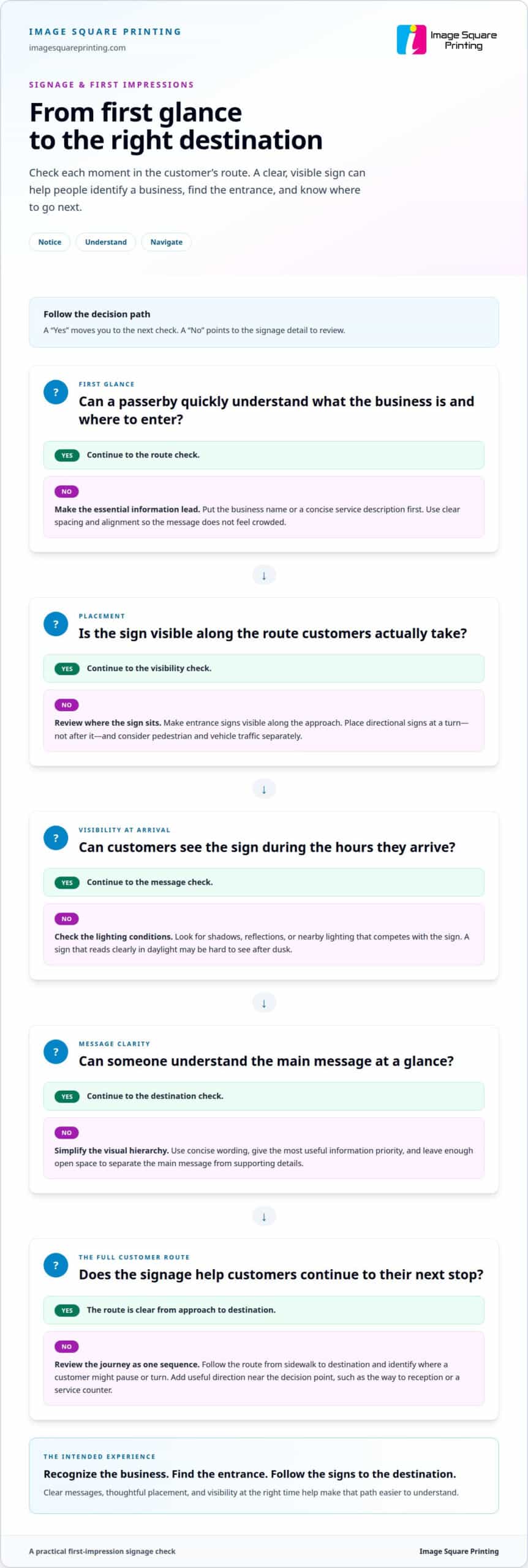
A sign often introduces a business before a customer reaches the entrance. Its condition, placement, lighting, and message quickly shape the impression people form. On a busy street, a clean, visible sign helps passersby identify the business, while a faded or obstructed one can leave them uncertain. That first visual encounter sets expectations before any interaction with staff.
Clarity matters in that brief encounter. A passerby may have only a moment to understand what a business offers and where to enter. Put the most useful information first, such as the business name or a concise service description. A restaurant, for example, might display its name prominently and place a readable entrance sign near the door. Details such as alignment and spacing help the message feel deliberate rather than crowded.
Placement determines whether a sign reaches its intended audience. An entrance sign should be visible along the route customers actually take, not hidden behind a doorway or display. A directional sign at a turn in a parking area can help visitors find the right entrance; one placed after the turn may come too late. Consider pedestrian and vehicle traffic separately, since drivers need a clear view without having to stop to read a long message.
Lighting affects both a sign’s visibility and the impression it creates. A sign that looks clear in daylight may be difficult to see after dusk, especially near a dim entrance. Check how it reads during the hours customers arrive, and look for shadows, reflections, or nearby lighting that competes with it. For example, a bright window display can make dark lettering on an adjacent sign harder to distinguish.
Design the message for a quick glance. Use concise wording, a clear visual hierarchy, and enough open space to separate the main message from supporting details. A retail window promoting a seasonal offer might emphasize the offer first, then show a short call to action. If every line competes for attention, customers may miss the information that would help them decide whether to enter.
First impressions also depend on whether signage matches the setting and the customer’s next step. A welcoming entrance sign can reduce hesitation, while an interior direction sign can guide visitors toward reception or a service counter. Review the route from sidewalk to destination as one sequence, identifying where a customer might pause or turn. For a storefront, outdoor sign design can help make the business visible and its entrance easier to identify.
Justifying signage upgrades with consumer research
Consumer research can connect sign quality and visibility with customer responses. Signage costs depend on format, dimensions, materials, and production needs, so request a quote to establish project pricing. Measure return by comparing changes in visits, inquiries, or purchases with the cost of the upgrade.
Consumer Research for Signage Upgrades
Consumer research uses customer feedback and behavior data to guide signage decisions. It helps businesses prioritize changes that address observed problems instead of relying only on personal preference. For example, customer comments about a hard-to-find entrance point to a visibility or wayfinding issue. A short survey can also ask whether signs look current, communicate clearly, and make the business feel professional.
Pair customer responses with observations. Note where people pause, miss a turn, or ask staff for directions, then compare those patterns with feedback. Research can help distinguish an outdated appearance from a practical navigation problem. That distinction makes an upgrade more targeted: improve the message, placement, or condition that is getting in the way of the customer’s next step.
Responses to Poor-Quality Signs
Poor-quality signs can undermine credibility before customers interact with staff or products. In the United States, 75% of consumers agree that chaotic, difficult-to-read signs make a business less credible. A faded sign or crowded message may therefore convey neglect, even when the underlying service is strong. The finding gives businesses a reason to review signs customers encounter first.
Readability also affects whether people can locate a business. In the United States, 41% of consumers report being unable to find a business because its sign was too difficult to read. A business can use customer comments and wayfinding observations to identify where visibility breaks down, such as a sign obscured from the street or directions that arrive after a turn.
Signage, Consumer Behavior, and Trust
Signage influences behavior by helping people notice a business, understand its offer, and decide whether to enter. In the United States, 82% of consumers say signage affects how much they trust a business. That response makes signage part of the customer experience, not simply a marker. Clear information at an entrance, for example, can reduce uncertainty about where to go.
Trust also connects with perceived quality. In the United States, 90% of consumers say signage affects whether they view a business as professional or high-quality. Businesses can use this insight to prioritize signs that carry essential information, especially where customers make a decision or need directions. Research indicates what matters to customers, while on-site observation reveals where a sign may fail to help.
Measuring Signage Effectiveness and Return
Measure signage effectiveness by comparing customer responses before and after an upgrade. Track relevant indicators such as foot traffic, inquiries, purchases, or repeated requests for directions. If a sign promotes a specific offer, compare redemptions before and after it is displayed. Use the same measures over comparable periods to make changes easier to interpret.
Connect the results to the upgrade’s cost to assess return on investment. For instance, if clearer wayfinding reduces missed appointments, record that change alongside customer feedback. Signage can affect several outcomes, so choose measures that match the sign’s purpose. Judge a directional sign by how well it supports navigation, and a promotional sign by the attention and action it generates.
Signage’s effect on purchase decisions, trust, and recall
Signs can attract attention, clarify an offer, and help a business stay memorable. Understanding how signage impacts customer perception helps businesses connect each sign with a useful customer action.
Signage and Purchase Decisions
Signage can influence purchase decisions by making a business visible and its offer easier to understand. In the United States, 84% of Americans say signage impacts their decision to buy from a business. A clear promotion near a relevant product, for example, can prompt customers to consider an option they might otherwise overlook.
Placement shapes that opportunity. A sign near an entrance can draw potential customers inside, while a product sign can make a key feature easier to notice. In the United States, 39% of consumers have entered a business solely because of its sign. A focused message gives interested passersby a reason to act, especially when it connects with an immediate need.
Trust and Credibility Cues
Trust cues are visual details that help customers judge whether a business seems credible and dependable. A well-maintained sign that is easy to understand and consistent with the business’s identity can support that impression. Peeling graphics or conflicting messages, by contrast, may make a business appear inattentive to detail.
Consistency matters when customers are deciding what to do. Someone who sees a clear service promise on a storefront expects to find the same message inside. Signs that meet that expectation create a coherent experience, while unclear directions or unrelated claims can weaken credibility. Each message should fit the business and support the customer’s next step. Research into how signage impacts customer perception can help identify which visual cues build confidence.
Customer Trust and Engagement
Engagement happens when a sign gives customers a useful reason to interact, such as exploring a product or scanning a QR code. Make the next action clear and relevant. For example, a QR code beside a product display can lead interested shoppers to more details and let them explore at their own pace.
Recall is another part of engagement. In the United States, 93% of consumers say a business’s signage affects whether they remember it. A distinctive message or graphic can help customers recognize the business later. The sign should reinforce the identity rather than compete with it through excessive text or visual clutter.
Accessibility and Readability for Different Customers
Accessible, readable signage helps people with different vision needs understand messages and navigate spaces. According to the U.S. Department of Justice, sufficient contrast between text and background helps people with limited vision or color blindness read colored text. Clear wording and legible type also help customers reading quickly or from a distance.
Readability affects whether customers can act on information. A visitor looking for a reception desk benefits from concise directions, while a shopper comparing products needs a message that is easy to scan. Strong contrast, clear type, and direct wording make signs more useful in both situations.
How can businesses measure the effectiveness of their signage?
Assess a sign against the job it was designed to do. A storefront sign should support discovery, while a wayfinding sign should help visitors reach a destination. Before judging results, define the intended customer action and record a baseline. For example, a clinic might track how often visitors ask where reception is before changing its directional signs.
Choose indicators that match the sign’s purpose. For a promotional sign, compare inquiries or purchases connected to the offer. For directional signage, observe whether visitors reach the intended area without staff assistance. A business can also ask customers how they found the entrance. These measures show whether the sign attracts attention, communicates clearly, and supports the next step.
Use a consistent comparison process so other changes do not distort the results. Record a baseline, install or update the sign, then track the same indicators under comparable conditions. If a store changes both its window display and sign, it becomes harder to tell which change influenced customer behavior. Keeping other promotions stable makes the comparison more meaningful.
- Set the objective: Define whether the sign should increase discovery, guide visitors, or promote an offer.
- Choose the measure: Track relevant observations, such as direction requests, offer inquiries, or visits.
- Record the baseline: Capture the same measure before the signage change.
- Compare results: Review the measure after the change and note other factors that could affect it.
Customer feedback adds context to the numbers. If visits increase but customers still ask where to enter, the sign may attract attention without solving the navigation problem. A brief question at checkout, such as “Was it easy to find us?”, can reveal issues that sales records alone will not explain. Staff observations can also identify repeated misunderstandings around a particular sign.
To assess return on investment, compare the outcome tied to the sign with the cost of producing and installing it. A promotional sign can be assessed against related sales or inquiries; a wayfinding sign may be judged by fewer interruptions and smoother visitor flow. The right measure depends on the business goal, so foot traffic is not the only sign of success.
Keep the findings actionable. If customers notice a sign but misunderstand its message, revise the wording or layout. If visitors miss it entirely, reassess its visibility and placement. Plan the signage project around the specific customer response you want to improve.
Image Square Printing
Image Square Printing helps businesses turn signage goals into polished printed visuals that support brand recognition and customer engagement. When research points to inconsistent branding, a hard-to-notice message, or a need to reinforce identity across a space, its custom printing options can support an update. Options include retractable banner stands, step and repeat backdrops, and custom wall coverings, tailored to the project’s visual needs.
Bring a clear objective to the project, such as making an event area more recognizable or extending brand graphics into an interior. Image Square Printing can help translate that direction into high-resolution printed materials, with attention to design and finish. To discuss signage and visual graphics for your business, contact Image Square Printing.
Make Your Next Signage Decision With Purpose
Understanding how signage impacts customer perception gives your next upgrade a clear purpose: address a customer-facing challenge, not simply refresh a surface. Start by identifying the moment that needs improvement, whether visitors hesitate at an entrance, overlook an offer, or struggle to connect a visual with your brand. Then define the response you want to encourage and use that goal to guide your design decisions.
That focus keeps creative choices tied to real business needs. Thoughtful visuals can make an experience feel more intuitive and give customers a consistent impression as they move from discovery to action. Treat signage as part of the customer journey, then refine it as your space, audience, and priorities evolve.
When you’re ready to turn that direction into a print project, contact Image Square Printing to discuss your signage needs. A clear objective is a strong starting point for your next step.
Frequently Asked Questions
How does signage affect customer perception of a business?
Signage shapes what customers infer about a business before they speak with anyone. A clear sign can help visitors decide whether a place suits their needs, while unclear wording can leave them uncertain. For example, a repair shop sign that names its service helps drivers distinguish it from nearby retailers. Customers also notice whether signs look cared for, which can influence what they expect from the experience inside.
What signage design elements influence trust and brand credibility?
Readable wording, an organized layout, and accurate information all support credibility. A clinic sign that clearly identifies reception, appointments, and check-in gives visitors practical confidence about what to do. Make sure every sign uses the correct business name and current details. A polished design cannot make up for incorrect hours or an outdated service description, so factual accuracy matters as much as visual presentation.
How do color, typography, and readability affect customer responses to signage?
Color, typography, and readability affect how quickly customers understand a sign and whether its tone feels appropriate. A pharmacy, for example, benefits from clear lettering and strong contrast that customers can read while approaching the counter. Decorative type may suit a special event but slow comprehension on a directional sign. Match design choices to the reading distance, lighting, and task customers face.
How does storefront signage influence foot traffic and purchase decisions?
Storefront signage can turn passing interest into a decision to enter by making the business and its offer easy to identify. A bakery displaying a concise message about take-home bread may appeal to someone passing during a commute. An entrance marker nearby can clarify where to go. Track which message or offer customers mention, then use that feedback to refine storefront communication.
What does research say about the impact of signage on sales and customer behavior?
The consumer findings discussed in this article indicate that signs can influence business discovery, trust, recall, and buying decisions. These responses explain why signage deserves consideration alongside other customer-facing investments, but they do not predict results for a particular business. To apply the insight, connect each sign to a measurable purpose, such as promoting a service, helping visitors find a department, or prompting product inquiries.
How do digital signs compare with static signs for customer engagement?
Digital signs can change messages or display interactive promotions, while static signs present a fixed message without waiting for content to update. A venue might use a digital display for changing event information and a static sign for a permanent entrance label. Choose based on how often the message changes and what customers need at that location, not simply on which format feels newer.
What signage mistakes can harm customer perception?
Common mistakes include using too much copy, placing a sign where displays block it, and leaving outdated information in view. A retail store with a discontinued offer still posted in its window, for example, can confuse customers at the entrance. Inconsistent directions may also send visitors toward closed areas. Review signs from the customer’s approach and remove messages that no longer serve a clear purpose.