
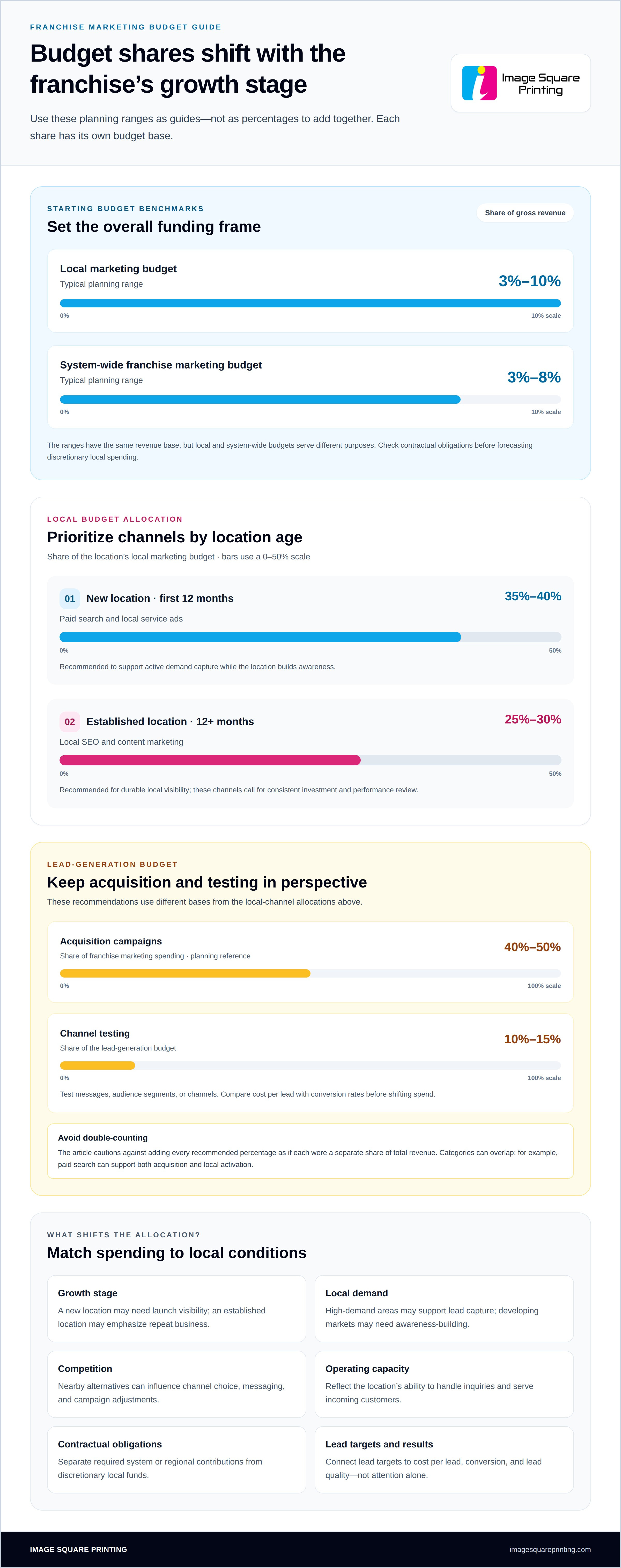
A franchise marketing budget is only useful when it supports both system-wide brand building and local customer acquisition. As a planning range, local marketing budgets typically run 3% to 10% of gross revenue, while system-wide franchise marketing budgets typically amount to 3% to 8%. The right allocation depends on contractual obligations, growth stage, market competition, and lead targets.
It’s reasonable to want a clear figure before committing funds, especially when franchise kits, local campaigns, and lead generation draw on the same budget. A practical budget allocation for franchise marketing kits plans for printed materials alongside digital campaigns, rather than treating either as a substitute for the other. Local demand, average transaction value, and customer acquisition costs also shape how to prioritize spending.
This guide explains what drives franchise marketing spending, how to divide funds between lead generation and brand materials, and how to build an annual plan that can adapt as results come in. You’ll also learn how to connect each budget category to a clear purpose and track performance over time.
Key Takeaways
- Separate required franchise fund contributions from local campaign spending so you can see which dollars are committed and which you can direct.
- Match lead-generation channels to the location’s growth stage, then track lead costs and conversions to guide adjustments.
- Build an annual plan around campaign timing, performance reviews, and a reserve for changing opportunities.
- Estimate marketing-kit production and shipping as project-specific budget items, accounting for quantities, materials, and delivery needs rather than relying on a universal price.
- Choose printed displays and branded materials according to how each location will use them, from local promotion to events.
Factors affecting franchise marketing budgets
A franchise marketing budget reflects more than a corporate target. The franchise agreement, local demand, competitive pressure, and each location’s growth stage shape what the budget must cover. First, separate required contributions from discretionary local funds. This distinction shows which dollars are committed and where managers can adjust campaigns, creative, events, and lead-generation activity.
Start with the governing documents. The franchise agreement, disclosure document, addenda, and referenced written policies can set contribution duties and local marketing expectations. The Electronic Code of Federal Regulations includes a disclosure item describing the franchise system’s advertising program. Use these documents to map system-level funds, regional co-op arrangements, and location-level requirements before forecasting campaign activity.
Market potential changes the role of each dollar. A location serving a dense area with established demand may prioritize customer retention and efficient optimization. A new territory may need more visibility, local partnerships, and lead generation. Compare the location’s audience, service area, and demand patterns, then align campaign activity with the customers most likely to respond.
Competition also influences the level and mix of investment. A crowded market may require sharper creative, a stronger local presence, or more frequent campaign adjustments. A franchise in a quieter market may focus on building awareness before scaling acquisition activity. Review nearby alternatives, the brand’s local visibility, and the location’s capacity to serve incoming customers.
Average transaction value and customer loyalty help clarify acquisition priorities. A location with repeat customers may balance retention and new-lead efforts differently from one relying on first-time purchases. Consider customer acquisition cost alongside conversion rates and lifetime customer value. These metrics show whether a campaign produces qualified demand, rather than simply generating attention.
- Growth stage: A new location may need launch visibility; an established location may emphasize repeat business.
- Local demand: A high-demand area may support lead capture, while a developing market may need awareness-building.
- Competition: Nearby brands influence channel choice, message, and campaign optimization.
- Operating capacity: Marketing should reflect the location’s ability to handle inquiries and serve customers.
Finally, set minimum and recommended spending guidance in the operations manual. This gives franchisees a consistent framework while leaving room for local execution. Review performance using lead quality, conversion, and revenue contribution. If an event attracts interest but few qualified prospects, adjust its role in the next planning cycle. This approach connects corporate standards with local market realities, making budget decisions easier to explain and improve.
Marketing and lead generation budget categories
A useful franchise budget separates campaign goals, channels, and delivery costs. Start by distinguishing lead acquisition from retention, brand support, and local activation. Franchise marketing budgets typically direct 40-50% of spending toward acquisition campaigns. Treat that as a planning reference, not an extra slice to add blindly to channel percentages.
For a new location’s first 12 months, paid search and local service ads are recommended to receive 35% to 40% of its local marketing budget. These channels can support active demand capture while the location builds awareness. Allocate funds based on the service area, lead volume targets, and the team’s ability to respond to incoming inquiries.
Established locations, operating for 12+ months, are recommended to assign 25% to 30% of local marketing budgets to local SEO and content marketing. These channels can build durable local visibility and answer customer questions over time. They usually need consistent investment and performance review, rather than a short burst tied to one promotion.
For lead-generation spending, connect the target number of leads to an estimated cost per lead. This is a planning example, not a promised result. Actual costs depend on channel, competition, audience, and campaign performance.
Keep channel testing inside the lead-generation plan. Franchise development teams are advised to reserve 10%-15% of that budget for testing. Use the amount to compare campaign messages, audience segments, or channels, then shift spending toward stronger results. Track cost per lead alongside conversion rates; inexpensive leads have limited value if they rarely become customers.
- Acquisition: Fund campaigns designed to generate inquiries and new customers.
- Retention: Support repeat visits and customer relationships.
- National and central support: Maintain consistent brand assets and shared campaigns.
- Local activation: Fund market-specific outreach, events, and community visibility.
- Testing: Set aside a defined share for measured experiments and optimization.
These categories overlap by design. Paid search can support both acquisition and local activation, while national creative can supply assets for local campaigns. Don’t add every recommended percentage as if each represents a separate share of total revenue. Define whether each percentage applies to the full local budget, the lead-generation portion, or another stated base. That keeps the plan clear and prevents double counting.
For event-led outreach, include practical materials in the activation plan. Event display planning can help connect the campaign’s message with a consistent in-person presence.
Annual franchise marketing budget template
Estimate kit spending per location by multiplying the quoted cost for each kit configuration by planned annual quantities, then adding distribution expenses. The total depends on the item mix, order volume, revisions, and shipping requirements. Pricing is provided by quote. A sound budget allocation for franchise marketing kits accounts for both recurring materials and campaign-specific orders.
Build the annual plan from the system’s revenue base, then separate central obligations from local spending. Franchise marketing budgets typically amount to 3%-8% of gross system-wide revenue, while local marketing budgets typically range from 3-10% of gross revenue. Treat these ranges as planning guidance and adapt them to the franchise’s circumstances. Franchise documents and operating policies determine required contributions.
For a location generating $1 million in annual revenue, an illustrative marketing investment is $60,000 to $80,000 annually, equal to 6% to 8% of gross revenue. Divide that annual amount into monthly planning targets, then assign each portion toward campaigns, local execution, retention, and shared brand support. The example offers a starting framework, not a universal allocation.
A separate illustrative monthly budget shows how obligations can sit beside discretionary spending. At $80,000 in monthly gross sales, the example assigns 2.0% of sales to the brand fund, 1.0% to a co-op, and 2.0% to required local marketing. The example illustrates how required contributions and other obligations can add up in a monthly plan. Keep each category distinct to avoid counting contributions twice.
- System and co-op contributions: Record required fund amounts and their timing.
- Local campaigns: Set monthly targets for media, events, and community outreach.
- Retention: Reserve funds for programs that encourage repeat business.
- Marketing materials: Estimate quantities by location, campaign calendar, and distribution schedule.
- Contingency: Preserve 10% to 15% of the annual budget for opportunistic spending.
Organize the calendar across 12 months, connecting planned spending to launches, seasonal demand, and local events. Forecast recurring expenses monthly, then review campaign performance monthly, budget and channel optimization quarterly, and strategic priorities annually. This rhythm helps teams adjust campaigns while keeping the full-year plan in view.
At the system level, one suggested allocation directs 70% toward hyper-local execution and 30% toward national brand support. Treat that split as a planning model, then adapt it to contractual obligations and market conditions. Track forecast versus actual spending by location; document whether variances reflect timing, demand, or campaign changes.
For each location, maintain a schedule showing kit contents, quantities, reorder timing, and delivery destinations. Multiply planned kit requirements by the annual order schedule, then roll the totals into the system budget. This makes the budget allocation for franchise marketing kits easier to compare across locations and revise when campaign plans change.
Benefits of managing franchise marketing budgets
A managed franchise budget gives corporate teams and local operators a shared view of priorities. Central oversight can support consistent brand standards, while local control leaves room for market-specific decisions. Documenting both roles helps prevent overlapping spending and makes each location’s responsibilities easier to understand.
Consistency matters when customers encounter the same franchise across different locations. A central plan can align campaign timing, visual identity, and core messages. Local teams can then tailor execution to nearby audiences and competition. For example, a national promotion can keep its core offer consistent while each location adapts its community outreach.
Centralized planning can also create economies of scale. Aggregated media buying across 50 or more franchise locations can deliver 15% to 30% cost savings compared with individual location purchasing. Shared planning also helps corporate teams coordinate campaign timing and negotiate media placements across markets. The benefit depends on coordinated buying, not simply consolidating budget spreadsheets.
Local control offers a different advantage: responsiveness. A location can adapt outreach to local demand, community partnerships, and competitive pressure. A national campaign may build awareness, while a local event or neighborhood promotion addresses a more immediate opportunity. Clear spending boundaries let managers act without losing sight of brand-wide priorities.
- Brand consistency: Shared standards help locations use aligned messages and creative.
- Cost efficiency: Coordinated purchasing can reduce duplicated planning across participating locations.
- Local relevance: Location teams can respond to community needs and nearby competition.
- Accountability: Documented budgets clarify which team owns each expense and decision.
A documented budget also strengthens accountability. Separate central, regional, and local expenses so stakeholders can trace how funds move. If two teams plan similar promotions, a shared view reveals the overlap before money is committed. It also gives franchisees a clearer basis for discussing priorities and reporting local activity.
Performance information becomes more useful when managed consistently. A shared reporting structure lets corporate teams compare locations using the same definitions. Local managers can see whether a campaign generated meaningful inquiries or merely broad exposure. Consistent records also help explain why spending changed, such as in response to a market shift or a new local opportunity.
Finally, transparent allocation supports better planning conversations. Franchisors can document typical responsibilities, approval steps, and reporting expectations in operating materials. Franchisees can then distinguish required contributions from locally managed decisions. This clarity reduces confusion during annual planning and helps teams direct resources toward activity that supports both the brand and individual locations.
A centralized franchise marketing budget can support brand consistency, economies of scale, and clear reporting from a single source. A localized franchise marketing budget can support focused local targeting, community partnerships, and flexible decision-making. Together, these approaches connect shared standards with local needs.
What are typical printing and shipping costs for franchise marketing kits?
Printing and shipping costs depend on the kit’s contents, quantities, production details, and delivery destinations. There isn’t one useful figure for every franchise. Estimate each location separately, then combine those estimates into an annual system budget. A kit containing printed handouts has different production and packing needs from one containing large-format displays.
Begin with the contents list. For each item, record its finished size, material, print requirements, and finishing details. A large sign, for example, has different material and packing needs from a stack of brochures. Consistent specifications across locations make estimates easier to compare and help prevent unexpected variations between franchise kits.
Quantity is another major cost driver. A consolidated order for many locations may be planned differently from separate orders placed throughout the year. However, the total depends on the exact mix, order timing, and fulfillment arrangements. Build a location-by-location quantity schedule that includes opening kits, replenishment, and campaign-specific materials.
Shipping depends on where kits must go and how they’re packed. Individual deliveries to separate locations differ from a shipment to one central destination for later distribution. Package size, weight, delivery address, and requested delivery timing all shape the shipping estimate. For an event kit, include its destination and arrival deadline in the planning details.
Use a simple estimate structure for each location:
- Production: List each item, specification, and quantity.
- Preparation: Include packing or sorting requirements for each destination.
- Delivery: Identify destinations and timing needs.
- Annual volume: Show planned initial orders and replenishment separately.
This breakdown gives finance and marketing teams a clearer comparison between locations. It also separates production from delivery, making it easier to identify why two kits differ. If one location needs a customized event package while others use standard materials, document that variation rather than averaging it across the franchise.
For annual planning, request a project-specific quote using the final item list, quantities, specifications, and delivery plan. Update the estimate when campaign schedules or location counts change. Don’t treat an older order as a current budget figure if its materials or destinations differ. A quote based on complete details gives the team a more relevant planning amount.
To scope printed materials for a franchise campaign, request a project-specific printing quote from Image Square Printing with the kit contents, quantities, and delivery requirements.
When calculating the budget allocation for franchise marketing kits, the investment should be evaluated on a recurring basis, but it should sit within the broader franchise budget rather than stand in for it. Franchise agreements typically require local marketing spending of 2% to 5% of gross revenue. Franchisees typically contribute at rates of 1% and 3% of gross revenue to a national advertising fund, while regional co-op advertising contributions typically range from 0.5% to 1.5% of gross revenue. These categories help teams distinguish location-level campaign materials from shared system activity when deciding how kits are funded.
Total marketing allocations can vary by sector and franchise system. Legal and compliance costs for active franchise development typically total 25,000-80,000 annually. Keep these obligations separate from print and freight estimates, then confirm which budget pays for each kit component.
Image Square Printing
Image Square Printing helps franchise teams turn marketing plans into consistent printed materials for local campaigns and events. When a budget includes physical brand assets, coordinated production can support a unified look across locations while keeping each kit aligned with its intended use.
Choose materials to suit the campaign: Retractable Banner Stands or Step and Repeat Backdrops can support event visibility, while Custom wallpaper printing and Custom wall covering can bring branded visuals into a location. Clear artwork, quantities, and delivery destinations help shape a practical project estimate for annual planning.
Contact Image Square Printing to discuss printed materials for your franchise marketing kit.
Make the Next Campaign Easier to Plan
A useful budget should guide decisions, not sit untouched after approval. Treat budget allocation for franchise marketing kits as part of an ongoing planning process: connect each printed piece to a campaign purpose, intended audience, and distribution plan. That makes it easier to decide what to keep consistent across locations and where local teams need flexibility.
Before the next campaign begins, align the creative direction with the places customers will encounter the brand. Printed materials can support in-person promotion, while custom wallpaper printing or custom wall covering can extend branded visuals into a location. The right combination depends on the campaign and how each franchise will use the materials.
When you’re ready to plan printed materials for your franchise, contact Image Square Printing to discuss the project. A clear brief gives your team a strong starting point for the next campaign.
Frequently Asked Questions
What is a typical budget for franchise marketing kits?
There’s no single typical budget for a franchise marketing kit; the total depends on its contents and distribution plan. A practical budget allocation for franchise marketing kits starts with a list of items and quantities, then accounts for artwork preparation, production, packing, and shipping. For example, a launch kit sent separately to each location may need a different fulfillment plan from replenishment materials shipped together. Use project-specific quotes to set the budget.
How should franchise marketing budgets be allocated between headquarters and franchisees?
Separate headquarters’ system-wide responsibilities from franchisees’ local campaign spending. Headquarters can manage shared brand assets, central campaigns, and reporting; franchisees can direct local activity toward community needs. Record required contributions separately from discretionary spending, then document who approves each expense. For example, a national promotion may use central creative while a franchisee plans local event materials within brand standards. This budget allocation for franchise marketing kits also clarifies which team plans and funds physical materials.
What factors cause franchise marketing kit budgets to vary by industry and location?
Kit budgets vary with campaign purpose, required materials, order quantities, location format, and shipping destinations. A retail opening kit may focus on in-store visuals, while a franchise participating in conventions may need event displays and branded materials. Locations receiving separate shipments also have different fulfillment needs from those supplied through one central distribution point. Industry competition and local campaign schedules can change what each kit needs to include.