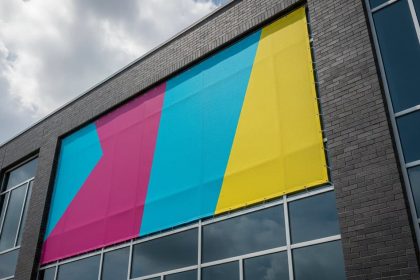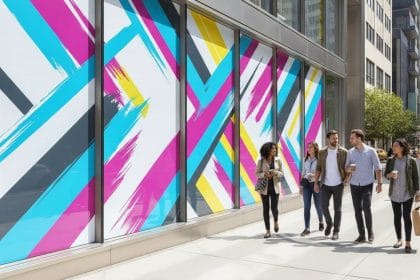

Choosing the most vibrant material for your outdoor display might actually be the fastest way to see your investment shredded by the next storm. When determining mesh vs vinyl banners: which is better?, the answer depends less on the design and more on the engineering of the installation site. You want a banner that commands attention with crisp graphics and professional branding, but the reality of high winds often turns a standard display into a sail that puts immense pressure on your hardware. It’s a common frustration that leads to wasted budgets and damaged property.
We’re here to help you move past the guesswork and select a material with technical precision. This guide explores the specific differences between these two industry staples to ensure your next project stays intact and impactful for six months or longer. We’ll preview the performance of perforated weaves that offer 37% open airflow and compare them against the high-density, smooth surfaces of traditional vinyl. Whether you’re wrapping a construction site or preparing for a high-stakes trade show, you’ll gain the insights needed for a seamless installation and a visual result that reflects your brand’s prestige.
Key Takeaways
- Identify the structural differences between 13oz scrim vinyl and perforated mesh weaves to select the substrate that matches your environment’s airflow requirements.
- Learn how to mitigate the “sail effect” on mounting hardware by choosing materials engineered to withstand high wind-loading without sacrificing professional brand visibility.
- Evaluate trade-offs in color saturation and print clarity to decide mesh vs vinyl banners: which is better? for your specific viewing distance and resolution needs.
- Identify high-impact use cases for each material, ranging from stadium fence wraps that require wind-permeable mesh to retail displays that demand high-resolution solid vinyl.
- Discover how professional finishing techniques like reinforced webbing and custom grommets extend the lifecycle and durability of your banner in high-pressure environments.
Understanding the Material Science: PVC Vinyl vs. Perforated Mesh
The foundation of a high-stakes visual campaign rests on the molecular structure of the substrate. Most professional displays utilize a polyester base reinforced by a specialized coating. When evaluating mesh vs vinyl banners: which is better?, you should start with the chemical composition. Vinyl banner materials typically feature a high-tenacity polyester scrim embedded between layers of PVC. This coating protects the core from moisture and structural fatigue. While solid vinyl remains the industry standard for durability, the introduction of perforated mesh has changed how we engineer large-scale graphics for high-wind environments.
Technical precision in the production phase prevents budget waste later. A 1000×1000 Denier count in the polyester base provides the tensile strength needed for long-term tension. If you ignore these specifications, you risk the banner sagging or tearing at the grommet points. By selecting the correct weight and weave early, you align your creative vision with the physical realities of the installation site. Your material choice dictates your design strategy from the very first draft.
The Anatomy of a High-Impact Vinyl Banner
Solid vinyl banners, ranging from 13oz to 18oz, offer a smooth, non-perforated surface that maximizes ink saturation. This density provides 100% opacity, ensuring that backlighting doesn’t wash out your brand colors. In 2026, the use of advanced UV-resistant inks is mandatory for any project facing direct sun exposure. These inks bond directly to the PVC, preventing the fading that often plagues lower-quality prints. For street-level promotions or outdoor signs where viewers are within ten feet, the solid surface of vinyl is the only way to maintain photographic clarity.
The Engineering Behind Breathable Mesh Banners
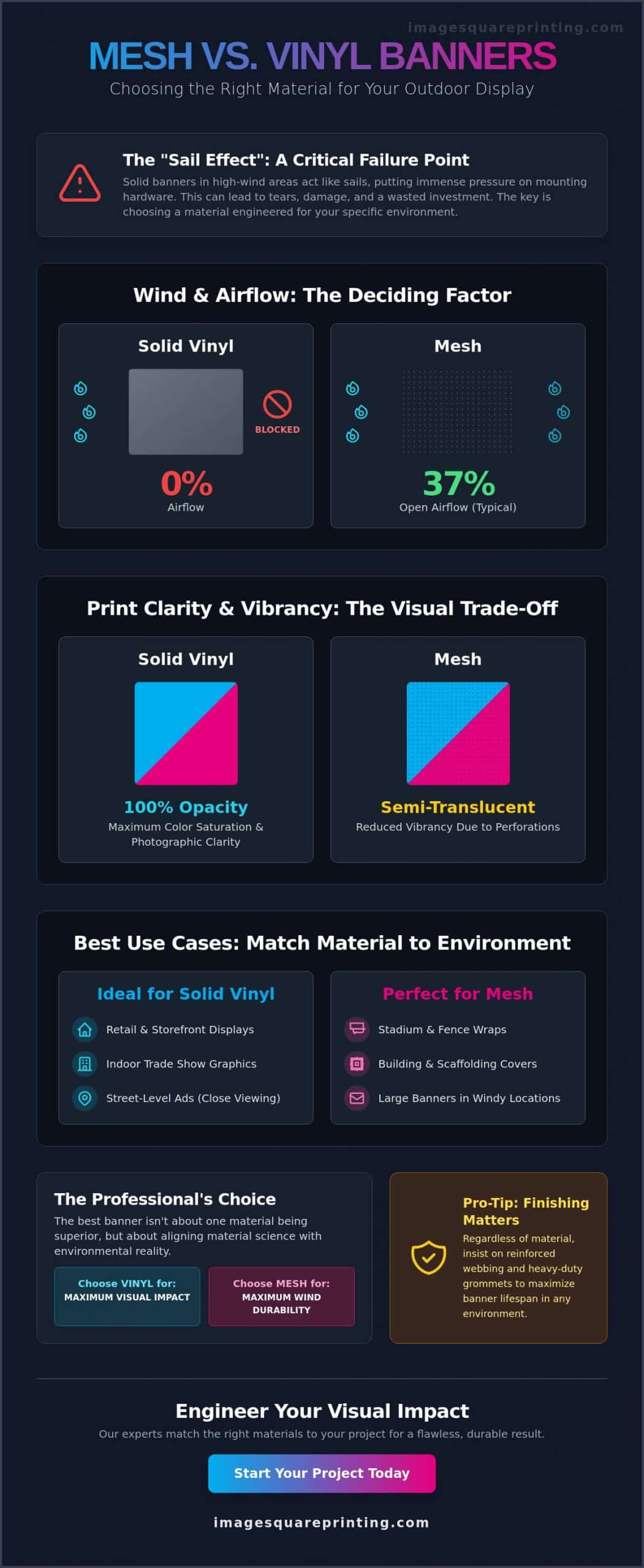
Mesh banners solve the “sail effect” through a calculated weave pattern, usually 70/30 or 50/50. This means 30% to 50% of the banner surface consists of micro-holes that allow air to pass through freely. This engineering reduces wind resistance by up to 70% compared to solid alternatives. It’s the primary reason mesh is the preferred choice for stadium fence wraps and scaffolding. However, there’s a technical trade-off. The same holes that allow airflow also reduce image density. Designers must use bold typography and high-contrast colors to compensate for the light that passes through the material, ensuring the message remains legible even in bright conditions. Determining mesh vs vinyl banners: which is better? ultimately requires balancing this need for airflow against the required level of detail.
Performance Under Pressure: Wind-Loading, Opacity, and Print Clarity
The structural integrity of an outdoor display is often tested by the very environment it aims to dominate. When you mount a large, solid banner in an open area, you’re essentially installing a sail. This “Sail Effect” occurs because standard vinyl surfaces don’t allow air to pass through, forcing the wind to push against the material with immense pressure. This force is transferred directly to your grommets and mounting hardware, often leading to catastrophic failure during high-wind events. Determining mesh vs vinyl banners: which is better? requires analyzing how these environmental forces interact with your chosen substrate.
While mesh solves the wind problem, it introduces a challenge with light transmission. Because mesh is perforated, backlighting from the sun can make the graphics appear translucent or “washed out.” Vinyl, however, offers 100% opacity. This makes vinyl the superior choice for color vibrancy and saturation. It holds ink on a solid plane, ensuring that every detail of your brand’s color palette remains crisp and punchy. For projects that must endure high-traffic street exposure, our outdoor signs provide the structural reinforcement and ink density needed for long-term reliability.
Solving the Wind Problem Without Unsightly Slits
Many providers suggest “wind slits” in vinyl banners to reduce pressure, but this is a flawed strategy. These half-moon cuts create immediate weak points where the polyester scrim can begin to fray and tear under stress. Instead of compromising the material’s surface, mesh banners utilize their inherent weave to distribute airflow evenly across the entire display. If your project requires the high-resolution finish of vinyl in a breezy corridor, the professional solution is to upgrade to an 18oz heavy-duty vinyl paired with reinforced webbing. Unlike standard hemming, reinforced webbing involves sewing a heavy-duty nylon strap into the banner’s edge, which distributes the wind load across the entire perimeter rather than just the grommet holes.
Visual Impact: Designing for Two Different Surfaces
Designing for mesh requires a different strategic approach than designing for solid vinyl. To combat the transparency of mesh, you should prioritize high-contrast color schemes and bold, thick typography. Intricate photographic details or small text will likely get lost in the perforated weave. Vinyl remains the only logical choice for step-and-repeat backdrops or retail displays where viewers are standing within arm’s reach. Mesh banners are most effective when viewed from a distance of 15 feet or more, where the human eye naturally blends the perforated gaps into a cohesive, high-impact image. By matching the design complexity to the surface texture, you ensure your visual investment delivers the intended prestige.
Strategic Use Cases: Matching Material to Environment
Massive arena branding and stadium fence wraps require more than just a large print; they require a sophisticated understanding of structural physics. For high-visibility projects spanning hundreds of linear feet, mesh is the undisputed leader. It manages the significant safety risks associated with high-altitude winds by allowing air to flow through the substrate, preventing the fence from acting as a barrier that could buckle under pressure. In these large-scale applications, the primary goal is a balance of safety and professional brand presence.
Street-level promotions demand a different standard of excellence. When a potential client stands inches away from your storefront, they expect the photographic depth and sharp detail that only solid vinyl provides. Inside a convention center, the transition to indoor prestige often involves trade show materials that prioritize color saturation over wind resistance. Determining mesh vs vinyl banners: which is better? for these environments usually depends on how close your audience will be to the graphic. If they can touch the banner, solid vinyl is the correct choice for representing your brand’s quality.
Outdoor Events and Festivals
Festival organizers often utilize mesh for stage backdrops and speaker covers because the perforated weave doesn’t dampen sound quality or obstruct airflow for electronic equipment. This technical advantage ensures the audio experience remains uncompromised while the brand remains visible. Conversely, for the red carpet and media zones, Step and Repeat Backdrops made from solid vinyl or fabric are essential. These materials provide a matte, opaque surface that prevents camera flash-glare from ruining high-profile photography, ensuring your sponsors receive the clean, professional exposure they expect.
Long-Term Commercial Signage
Permanent installations require a calculation of the total cost of ownership over several years. While mesh handles wind better, its perforated surface can trap urban pollution, dust, and debris over time, which may dull the graphics more quickly than a smooth surface. For multi-year branding on building facades or sheltered entryways, heavy-duty Outdoor Signs crafted from premium vinyl often retain their vibrant luster longer. Deciding mesh vs vinyl banners: which is better? for your business usually comes down to whether you are fighting constant wind or battling urban grime. If your location is a sheltered city street, the easy-to-clean nature of solid vinyl offers a more reliable, long-term visual solution.
The Professional’s Selection Matrix: Cost, Durability, and Longevity
A sophisticated procurement strategy looks beyond the initial invoice. When deciding mesh vs vinyl banners: which is better?, you must calculate the Total Cost of Ownership (TCO). A standard vinyl banner might cost less upfront, but if it requires replacement after a single windstorm, the “cost of failure” far outweighs the savings. Investing in high-performance substrates from the start ensures your brand remains visible without constant maintenance or re-ordering fees. As we move through 2026, many industry leaders are also prioritizing sustainability by selecting recyclable banner materials and eco-solvent inks that reduce environmental impact without compromising visual saturation.
Maintenance plays a vital role in extending the life of your investment. You should always roll your banners rather than folding them. Folding creates permanent creases that can crack the PVC coating and disrupt the printed graphic, especially on high-density vinyl. Rolling preserves the smooth surface and prevents the material from becoming brittle over time. If you need a reliable partner for these high-stakes projects, you can order custom outdoor signs that are engineered for long-term durability.
Technical Breakdown: Denier and Weight
Technical specifications like Denier and weight are the true indicators of material quality. Denier measures the thickness of the individual polyester fibers in the internal scrim. A 1000×1000 Denier count is critical for heavy-duty applications because it provides the structural backbone needed for superior grommet retention. Weight is measured in ounces per square yard; a higher weight typically signifies a thicker, more tear-resistant material. A 13oz vinyl banner typically offers a tensile strength of 150 lbs per inch. When you compare this to reinforced mesh weaves, you can accurately judge which substrate will survive the specific stresses of your installation site.
Finishing Options That Prevent Failure
The edges of your banner are its most vulnerable points. Heat-welded hems are generally superior to double-stitched edges because they fuse the material layers into a single, cohesive bond that won’t fray or unravel. For banners exceeding 50 square feet, corner reinforcements are a necessity. These additional layers of material distribute the tension across a larger area, preventing the grommets from pulling through the substrate. In extreme wind-load scenarios, we often recommend a rope-in-hem or heavy-duty webbing. This technique involves sewing a nylon cord or strap directly into the perimeter, providing a structural frame that allows the banner to withstand forces that would shred standard displays. When evaluating mesh vs vinyl banners: which is better? for a high-pressure site, these finishing details are just as important as the material itself.
Engineering Your Visual Impact with Image Square Printing
Transforming technical specifications into a visual landmark requires a partner who treats your brand with the precision of a master craftsman. At Image Square Printing, we don’t just print graphics; we engineer durable communication tools. Our commitment to high-resolution output ensures that whether you choose a solid or perforated substrate, the final result represents your brand’s prestige with absolute clarity. We specialize in navigating the complexities of large-format production, moving seamlessly from a single storefront banner to massive, national multi-location rollouts without compromising on detail.
When clients ask us mesh vs vinyl banners: which is better?, we provide an answer grounded in site-specific data. Our pre-press team performs rigorous file optimization to ensure your artwork translates perfectly to the chosen material. For mesh banners, this involves adjusting color contrast and trapping to prevent the perforated weave from softening your message. We also provide professional finishing services that act as a safeguard against environmental stress. From heat-welded hems and brass grommets to heavy-duty pole pockets and reinforced webbing, every detail is designed to keep your display secure in high-pressure environments.
The Image Square Advantage
Our strategic presence in Southern California and Nevada production hubs allows us to offer rapid delivery and localized expertise to a nationwide clientele. This regional heritage serves as a shorthand for quality, positioning us as a proactive partner for high-visibility projects in the country’s most demanding markets. We take a collaborative approach to every order, consulting on the physics of your installation site to ensure your creative vision remains intact. Whether you’re planning a stadium-scale wrap or a high-rise graphic, our team provides the technical oversight needed to remove friction from the production process.
Ready to Start Your Project?
We’ve designed our workflow to meet the high standards of modern marketing agencies and corporate accounts. You can easily request a custom quote for your mesh or vinyl project, or access our dedicated corporate portal for streamlined, high-volume ordering. This system allows you to manage complex brand assets and maintain consistency across multiple regions with ease. If you’re ready to see your vision brought to life with technical precision and quiet confidence, design your high-impact outdoor banner with Image Square Printing today. We are obsessed with the details, ensuring your next project stands as a testament to your brand’s reliability and impact.
Maximize Your Brand’s Outdoor Presence
Selecting the right substrate is a strategic decision that balances environmental physics with visual impact. Whether you prioritize the wind-permeable weave of mesh for a stadium fence or the 100% opacity of heavy-duty vinyl for a retail storefront, your choice defines the longevity of your campaign. When determining mesh vs vinyl banners: which is better?, the answer lies in the specific wind loads and viewing distances of your installation site. Aligning your creative vision with these technical realities prevents budget waste and ensures a professional finish that lasts.
Since 2003, Image Square Printing has delivered large-format expertise to clients who demand technical precision and reliability. We leverage our production hubs in Los Angeles and Las Vegas to provide rapid nationwide shipping, ensuring your high-stakes projects arrive on schedule. Our pre-press team performs rigorous file verification to guarantee that your graphics represent your brand with absolute prestige. Order Custom Mesh or Vinyl Banners for Your Next High-Impact Project and experience the master craftsman’s approach to modern branding. Your vision deserves a substrate that can withstand the elements while commanding attention.
Frequently Asked Questions
Is mesh or vinyl better for high-wind areas?
Mesh is the superior choice for high-wind environments because its perforated weave allows air to pass through the substrate. High-quality mesh can withstand wind loads of 60 to 90 mph in specific installations. This engineering reduces the physical stress on your mounting hardware and prevents the banner from tearing during unpredictable weather events.
Can you see through a mesh banner from a distance?
You can’t easily see through a mesh banner once you move beyond a viewing distance of 15 feet. While the material has approximately 37% open airflow, the human eye naturally blends the printed sections into a solid image at a distance. This makes mesh an excellent solution for massive building wraps or stadium fencing where both visibility and airflow are required.
Which banner material has better print quality for photos?
Vinyl offers the highest print quality for photographic details and intricate brand assets due to its smooth, non-perforated surface. It allows for maximum ink saturation and sharper resolution than mesh. When deciding mesh vs vinyl banners: which is better? for a trade show or retail display, choose vinyl to ensure your colors remain vibrant and your text stays legible up close.
How long do vinyl banners last outdoors compared to mesh?
High-quality vinyl banners typically last between six months and one year in standard outdoor conditions, while top-grade mesh with UV coatings can retain its structural integrity for two years or more. Mesh often outlasts vinyl in exposed areas because it doesn’t suffer from the structural fatigue caused by constant wind resistance. Both materials benefit from advanced inks that prevent fading under direct sun exposure.
Are mesh banners more expensive than standard vinyl?
Mesh banners are generally more expensive than standard vinyl because the production process involves a more specialized perforated weave. While the initial investment is higher, the total cost of ownership is often lower for outdoor projects. Mesh reduces the risk of banner failure in storms, saving you the expense of emergency replacements and hardware repairs.
Can I use a vinyl banner for a fence wrap?
You can use a vinyl banner for a fence wrap only if the location is sheltered from the wind. In open areas, a solid vinyl banner creates a sail effect that can pull down the fence or shred the grommets. For most perimeter fencing and construction sites, mesh is the safer and more professional recommendation to manage airflow effectively.
How do I clean and store my banners to prevent wrinkles?
Clean your banners with a soft cloth and mild, non-abrasive soap before rolling them tightly around a core for storage. Don’t fold your banners, as this creates permanent creases that can crack the ink and the PVC coating. Rolling ensures the material remains smooth and ready for a professional installation at your next event.
What is the best way to hang a large outdoor banner safely?
The safest way to hang a large outdoor banner is to use reinforced webbing and high-strength grommets paired with bungee cords or heavy-duty zip ties. These fasteners provide the necessary tension while allowing for slight movement during gusts. When evaluating mesh vs vinyl banners: which is better? for a high-altitude mount, always prioritize hardware that distributes the load across the entire perimeter of the display.