
The most expensive banner you’ll ever buy is the one you have to replace twice in a single season. It’s a common frustration for marketing managers who watch their high-stakes displays rip in high winds or fade under the summer sun after just two weeks. Selecting the best banner materials for outdoor use is about more than just picking a thickness; it’s a strategic decision that impacts your brand’s perceived value. If your signage looks cheap or weathered, your potential clients will assume your service follows suit.
We understand that your projects demand both visual impact and technical precision. You need a solution that remains vibrant and structurally sound regardless of local weather challenges. This guide reveals the engineering specs and high-performance substrates required to maintain brand prestige in the harshest environments. We’ll explore the critical differences between standard 13 oz. vinyl and heavy-duty 18 oz. options, the mechanics of wind-resistant mesh, and the fire safety standards like NFPA 701 that keep your displays compliant. By the end, you’ll have the technical knowledge to choose the perfect material and finishing for your specific climate and application.
Key Takeaways
- Learn how advanced UV-resistant pigments and high-grade polymers protect your brand’s visual impact from extreme environmental stress.
- Compare the engineering of 13oz and 18oz scrim vinyl to determine the best banner materials for outdoor use based on your project’s duration.
- Understand the physics of the 70/30 mesh weave and how it balances airflow with color density in high-wind environments.
- Discover why heat-welded hems and nickel-plated brass grommets are the professional standards for preventing edge failure and rust.
- Apply a strategic decision matrix to select the ideal material texture and resolution for your specific viewing distance and brand goals.
The Science of Outdoor Durability: Why Material Choice Matters
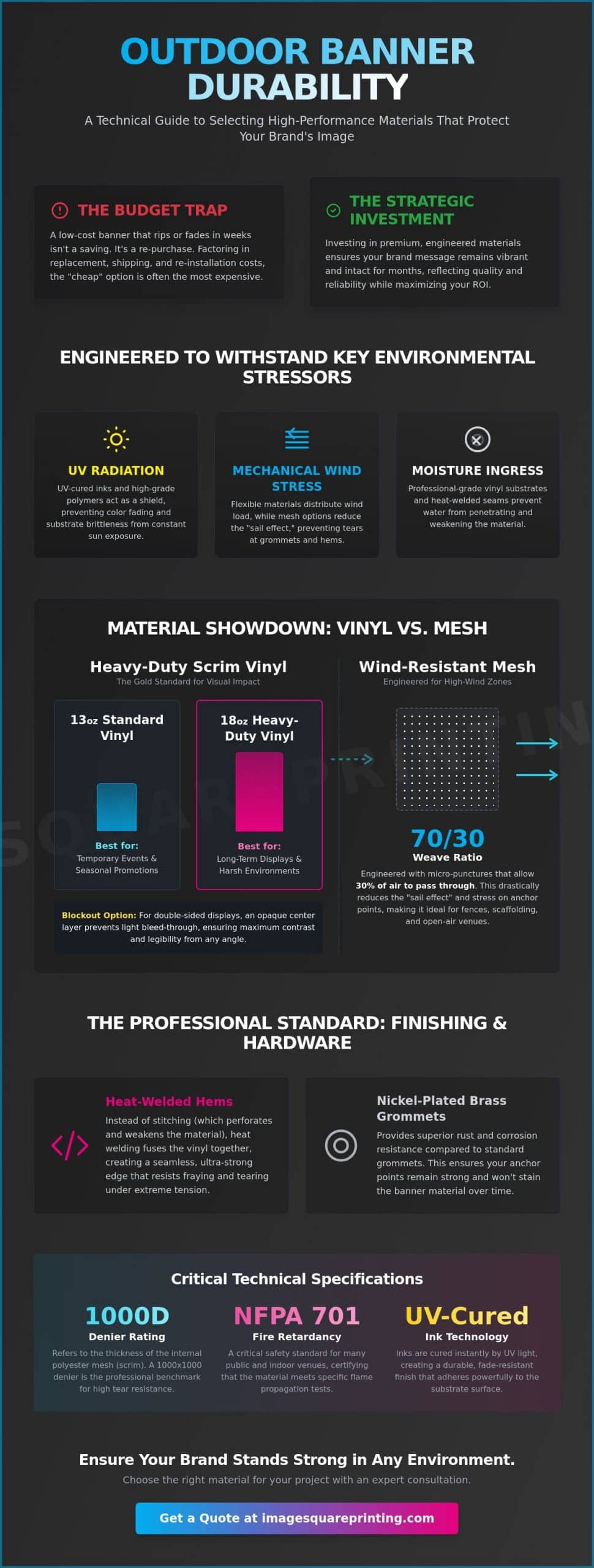
Outdoor durability is often misunderstood as simple toughness. In professional printing, we define it as a material’s calculated resistance to three specific stressors: UV radiation, moisture ingress, and mechanical wind stress. As we move through 2026, environmental factors have become more aggressive. Higher average temperatures and erratic storm patterns mean that standard substrates no longer suffice. Achieving brand prestige requires a shift toward visual graphics engineering, where we select higher-grade polymers and specialized pigments designed to survive these shifts. Choosing the best banner materials for outdoor use isn’t just about aesthetics; it’s a technical requirement for any high-stakes project.
Many marketing managers fall into the trap of the “budget” banner. While a low-cost option might look acceptable on day one, the cost-to-longevity ratio is often poor. If a banner fails after three weeks of sun exposure or a single high-wind event, you aren’t just paying for a replacement. You’re paying for additional shipping, rush production, and the labor of re-installation. Even worse, a failing banner reflects poorly on your brand’s reliability. Investing in premium outdoor signs and banners from the start ensures your message remains crisp and authoritative for months, not days. We treat every project as a collaborative partnership, ensuring the technical specs match your specific local climate.
Understanding UV Degradation and Color Fastness
Sunlight is the primary enemy of outdoor graphics. Ultraviolet rays act as a catalyst that breaks down the chemical bonds in standard inks, leading to rapid fading. To combat this, we utilize UV-cured inks and specialized protective coatings that act as a shield for the graphic layer. High-resolution output must be paired with UV-resistant Vinyl banner materials to prevent the substrate itself from becoming brittle. In the current landscape, using pigments with high lightfastness ratings is the only way to ensure your brand colors stay true to your style guide under constant exposure.
Wind Load and Mechanical Stress Factors
A banner acts exactly like a sail. When wind hits a flat, rigid surface, it creates immense mechanical stress on the grommets and hems. This “sail effect” is why material flexibility is just as vital as tensile strength. A material that’s too rigid will snap under pressure, while a flexible, high-performance polymer can distribute the load more effectively. Identifying high-risk zones, such as narrow urban alleys that create wind tunnels or exposed rooftops, is a critical step in the selection process. For these environments, we often recommend moving beyond solid surfaces to engineered solutions that allow air to pass through without sacrificing visual impact.
Heavy-Duty Scrim Vinyl: The Gold Standard for Impact
Scrim vinyl represents the intersection of durability and high-fidelity aesthetics. It’s the primary choice for brands that refuse to compromise on visual impact. At its core, scrim vinyl isn’t just a sheet of plastic; it’s a composite material featuring an internal polyester mesh. This internal structure provides the tensile strength required to withstand the physical demands of the outdoors. When you’re evaluating the best banner materials for outdoor use, the weight of the material tells a story of intended longevity and environmental resistance.
Standard 13oz vinyl remains a versatile option for seasonal promotions or temporary event signage. However, for 2026, we increasingly recommend 18oz heavy-duty vinyl for any project intended to last more than a few months. This heavier substrate offers a premium feel and superior resistance to the “edge curl” that often plagues thinner alternatives. For high-visibility areas where the sun might wash out your graphics, blockout vinyl is essential. It features an opaque center layer that blocks light entirely, making it the perfect candidate for double-sided displays. This ensures your high-resolution, high-contrast branding stays sharp and professional from every angle.
The Role of Denier in Tear Resistance
Technical specifications like denier often separate professional-grade signage from hardware-store alternatives. Denier is a unit of measure that describes the weight and thickness of the internal polyester threads. For high-performance outdoor security, 1000×1000 denier is our established benchmark. This dense weave acts as a built-in safety net. If the banner is snagged or punctured, the tightly woven threads prevent the tear from traveling across the material. This engineering prevents the catastrophic failures and edge fraying that can quickly ruin a brand’s prestige. It’s this level of master craftsmanship that ensures your investment remains intact through unpredictable weather cycles.
Best Use Cases for Solid Vinyl Banners
Solid vinyl is the premier choice when color vibrancy and fine detail are non-negotiable. It’s the ideal material for wall-mounted building wraps and storefront advertising where customers see the graphics up close. Because the surface is continuous and smooth, it allows for the highest possible print resolution. This makes it particularly effective for short-term event banners where you want the colors to pop with maximum intensity. If you’re planning a high-visibility campaign, choosing the right outdoor signs starts with matching the substrate to your specific environment. You can learn more about optimizing your display in our complete guide to vinyl banners.
Mesh Banners vs. Vinyl: Engineering for High-Wind Zones
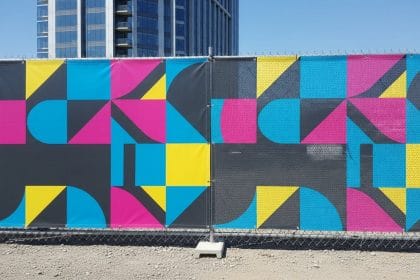
Solid surfaces fail when the wind picks up. While heavy-duty vinyl is unmatched for vibrancy, it essentially acts as a sail in open environments, exerting massive pressure on your mounting hardware. To solve this, we turn to the science of perforation. By utilizing a 70/30 weave, which consists of 70% printable surface area and 30% air-flow perforation, mesh banners effectively neutralize the “sail effect” that destroys solid vinyl in exposed zones. This specific engineering makes mesh one of the best banner materials for outdoor use when your project is destined for a wind-heavy location.
The primary advantage of mesh lies in tension reduction. Because 30% of the wind passes directly through the material, the mechanical stress on grommets and zip ties is significantly lower than with solid alternatives. This allows for larger displays without the need for reinforced, industrial-grade mounting structures. While there’s a slight trade-off in “perceived” color density due to light passing through the gaps, the structural integrity and safety benefits for public spaces are non-negotiable. It’s a strategic choice that prioritizes longevity and safety in high-stakes urban environments.
When to Choose Mesh Over Scrim Vinyl
Open-air environments demand specialized substrates. Construction sites, stadium fences, and bridge scaffolding are the primary domains for mesh. In these settings, the banner must withstand constant gusts without tearing or pulling away from the structure. For large-scale building covers, the reduced weight of mesh also simplifies the installation process and lowers the load on the building’s facade. If your project involves these high-risk zones, you can explore our technical specifications for mesh banners to ensure your brand remains visible and secure.
Visual Strategy for Perforated Materials
Designing for mesh requires a master craftsman’s eye for contrast. Since 30% of the material is missing, colors can appear slightly less saturated than on solid vinyl. We recommend using bold, high-contrast color palettes and thick typography to offset the air gaps. Brand prestige isn’t lost on these “transparent” substrates; it’s simply a matter of scale. From a viewing distance of 10 feet or more, the human eye “fills in” the perforations, making the image appear solid and vibrant. This allows you to maintain a premium brand image while benefiting from the superior wind resistance that only an engineered mesh can provide.
Advanced Finishing: Ensuring Your Banner Survives the Season
Even the best banner materials for outdoor use will fail prematurely if the finishing isn’t engineered for the environment. Think of finishing as the structural skeleton that supports your visual assets. While many providers rely on standard stitching, we prioritize heat-welded hems for high-stakes projects. Stitched hems create thousands of microscopic needle perforations that act as tear-points under mechanical wind stress. Heat-welding uses high-frequency thermal energy to fuse the vinyl layers into a single, unbreakable bond. This process creates an edge that is significantly stronger than the material itself, ensuring your display remains taut and professional through every storm.
Structural integrity also depends on the hardware used to pierce the substrate. Nickel-plated brass grommets are our non-negotiable standard for outdoor security. Unlike cheap steel alternatives that rust within weeks of exposure to coastal humidity, nickel-plated brass remains corrosion-free and maintains its grip. We pay particular attention to reinforced corners, which are the most common failure points in any outdoor installation. By adding a secondary layer of high-denier material to these high-stress zones, we distribute the wind load across a larger surface area. For street-pole displays, pole pockets are the preferred choice, as they allow for even tensioning and prevent the “gathering” effect seen with grommet-only mounting.
Ink Chemistry: UV-Cured vs. Solvent Technology
Ink chemistry is the final layer of your brand’s defense. For 2026, UV-cured inks have become the professional benchmark for scratch and fade resistance. Unlike traditional solvent inks that rely on evaporation, UV-cured pigments undergo an instant chemical reaction under ultraviolet light. This creates a hard, durable film that bonds permanently to the substrate. This “instant-dry” advantage is critical for preventing ink migration in humid or rainy conditions. Ensuring your large format printing uses this technology is the only way to guarantee your brand’s prestige remains intact for the long haul.
Hardware and Mounting Accessories
The method you use to secure your banner determines its lifespan. While heavy-duty zip ties are convenient, bungee cords are often superior for large-scale displays because they provide “give.” This flexibility allows the banner to absorb wind energy rather than resisting it until it snaps. For ground-level messaging, A-frame stands offer a stable, portable solution that keeps your graphics at eye level. If your location demands a rigid material rather than a flexible substrate, you should consider our specialized outdoor signs for maximum durability. Secure your next high-visibility project with our professional-grade outdoor signage solutions today.
Strategic Selection: Matching Material to Your Brand Goal
Choosing the best banner materials for outdoor use requires a framework that balances your campaign duration with your visual requirements. We view material selection as a strategic ROI calculation rather than a simple purchase. For temporary event signage lasting less than six months, a standard 13oz vinyl is often sufficient. However, for permanent installations or multi-year campaigns, 18oz heavy-duty scrim vinyl is the professional benchmark, offering a lifespan of three to five years. If your branding requires a permanent architectural presence, we often recommend moving beyond flexible substrates to rigid solutions like Aluminum Signs or Acrylic Signs, which provide unmatched prestige and structural longevity.
Viewer distance is the second critical factor in your selection matrix. For storefront displays where customers are within five feet, the material texture and print resolution must be flawless. In these scenarios, solid vinyl provides the smooth surface necessary for high-fidelity graphics. Conversely, for roadside banners or large-scale building wraps viewed from 50 feet away, the 30% air gaps in a mesh banner become invisible to the naked eye. This allows you to leverage the engineering benefits of wind resistance without sacrificing the perceived quality of your brand. At Image Square Printing, we act as your collaborative partner to ensure the technical specs of your substrate align perfectly with your environmental challenges.
Sustainability in 2026: Eco-Friendly Outdoor Options
Corporate ESG goals are increasingly influencing procurement decisions in the print industry. As we move through 2026, PVC-free banner materials have emerged as a high-performance alternative to traditional vinyl. These recyclable substrates can last up to two years outdoors, providing a significant window for most marketing cycles while reducing environmental impact. We stay ahead of shifting PFAS regulations and environmental marketing standards to ensure your displays are both compliant and responsible. By integrating these materials into your campaign, you demonstrate a commitment to innovation that resonates with modern, conscious consumers.
Next Steps: Professional Consultation and Production
Large-scale outdoor campaigns across multiple locations require more than just a printer; they require a logistics partner. For high-stakes installations, a technical site survey is vital to assess wind loads and mounting surfaces accurately. Our corporate portal is designed to streamline this process, allowing marketing teams to manage complex, multi-city rollouts with precision and speed. We focus on removing friction from the production cycle, moving your vision from concept to high-impact reality in record time. Don’t leave your brand’s outdoor presence to chance. Start your high-impact outdoor project today and experience the reliability of master-crafted signage.
Elevate Your Brand with Technical Precision
Professional signage is an investment in your brand’s long-term reputation. You’ve learned that outdoor durability isn’t just about material thickness; it’s a calculated synergy of substrate weave, UV-cured ink chemistry, and engineered finishing. Whether you’re deploying a high-wind mesh fence wrap or a vibrant building display, matching the technical specifications to your local environment prevents costly replacements and maintains your visual prestige. Selecting the best banner materials for outdoor use is the foundation of a successful, high-stakes campaign.
At Image Square Printing, we bring over 20 years of large-format engineering experience to every project. We don’t just print; we build solutions with expert finishing like heat-welded hems and reinforced corners to ensure your graphics withstand mechanical stress. Our high-resolution UV-cured printing guarantees that your brand colors remain vibrant and fade-resistant long after the initial installation. Your vision deserves a collaborative partner who is as obsessed with detail and quality as you are. Let’s build a display that makes a lasting impact on your audience.
Get a Custom Quote for Your Durable Outdoor Banners
Frequently Asked Questions
What is the most durable banner material for high-wind areas?
Mesh banners are the most durable solution for high-wind zones. Their engineered 70/30 weave allows 30% of airflow to pass directly through the material, which effectively neutralizes the “sail effect” that destroys solid surfaces. This perforation reduces the mechanical load on your mounting hardware and prevents the substrate from tearing during heavy gusts.
How long do vinyl banners typically last outdoors before fading?
Standard 13 oz. vinyl banners generally last between one and two years, while heavy-duty 18 oz. versions can maintain their integrity for three to five years. Selecting the best banner materials for outdoor use must include a focus on UV-cured inks to prevent significant fading within the first few months. Local climate factors, such as extreme heat or constant moisture, will ultimately dictate the exact lifespan of your display.
Is mesh or vinyl better for a fence banner?
Mesh is the superior choice for fence banners, especially on chain-link structures. Because mesh allows wind to pass through, it won’t pull on the fence or create dangerous tension points like solid vinyl would. While vinyl offers higher color density, mesh provides the necessary structural safety for open-air environments while appearing solid from a distance of ten feet or more.
Can outdoor banners be recycled or are they eco-friendly?
Yes, many modern outdoor banners are now available in PVC-free versions that are fully recyclable. These environmentally responsible substrates can last up to two years outdoors and help corporations meet their ESG goals. It’s important to coordinate with a provider that offers professional disposal or recycling programs to ensure the materials are processed correctly after your campaign ends.
What is the difference between 13oz and 18oz vinyl weights?
The difference lies in the density of the internal polyester scrim and the thickness of the vinyl coating. A 13oz vinyl is a versatile, standard-weight material perfect for seasonal promotions or temporary events. In contrast, 18oz vinyl is a heavy-duty substrate designed for long-term installations, offering maximum tear resistance and a premium, opaque finish that prevents light from shining through.
How do I prevent my outdoor banner from ripping at the grommets?
Preventing grommet failure requires a combination of heat-welded hems and reinforced corners. Stitched hems create needle holes that act as weak points, but heat-welding fuses the layers together for a bond that’s stronger than the material itself. Using nickel-plated brass grommets and flexible bungee cords also helps the banner absorb wind energy rather than resisting it until the substrate snaps.
Are fabric banners suitable for long-term outdoor use in 2026?
Fabric banners aren’t typically recommended for long-term outdoor exposure. While they provide a sophisticated, matte aesthetic for indoor events, they are prone to moisture absorption and wind-related fraying when left outside. For any project intended to last several months, heavy-duty vinyl or mesh remains the more reliable choice for maintaining brand prestige and structural integrity.
What kind of ink is best for banners exposed to direct sunlight?
UV-cured inks are the industry standard for banners facing direct solar exposure. These inks undergo an instant chemical reaction under ultraviolet light during the printing process, creating a durable, fade-resistant film that bonds permanently to the substrate. This technology ensures that your high-resolution graphics remain vibrant and crisp even in high-UV environments where solvent-based inks might fail.