
Your high-visibility outdoor signage isn’t a sail, and treating it like one is a recipe for project failure. In high-stakes environments where wind loads can reach 90 mph, traditional vinyl often fails, but mesh banners are engineered aerodynamic tools designed to maintain structural integrity. You’ve likely felt the frustration of a banner ripping from its grommets or seen graphics that lose their punch due to improper perforation ratios.
We understand that your brand’s reputation depends on signage that looks professional and stays secure, regardless of the weather. This guide provides the technical roadmap to mastering material weights like 8 oz. vinyl and the latest 2023 NFPA 701 flame propagation standards. You’ll learn how to balance the 70:30 airflow ratio with high-impact design strategies to ensure your display is both safe and visually stunning. We’re covering everything from wind-load engineering to the specific installation techniques that turn a simple fence wrap into a sophisticated brand statement.
Key Takeaways
- Learn how the 70/30 airflow rule prevents wind damage while maintaining enough surface area for vibrant branding.
- Identify whether 8 oz or 12 oz material is the right choice for your specific environmental conditions and project duration.
- Discover why bold, high-contrast design elements are essential for mesh banners to ensure your message doesn’t get lost in the weave.
- Compare the weight and opacity of mesh versus solid vinyl to make informed decisions for high-stakes outdoor displays.
- Optimize your production workflow by using professional pre-press services that specialize in large-format, high-visibility projects.
Understanding Mesh Banners: The Science of Airflow and Visibility
High-impact outdoor advertising demands more than just a vibrant image; it requires an engineering solution that respects the laws of physics. Traditional solid vinyl is a powerhouse for indoor displays, but when moved to open outdoor spaces, it often transforms into a liability. Mesh banners solve this challenge through a sophisticated perforated polyester-reinforced vinyl construction. This material is specifically designed to survive in high-wind environments where standard signage would likely shred or pull its mounting hardware clean out of the wall.
The secret to this durability is the 70/30 airflow rule. In this configuration, 70% of the material’s surface area is reserved for high-resolution printing, while the remaining 30% consists of microscopic holes that allow air to flow through the fabric. This ratio is the “sweet spot” for modern production. It provides enough surface tension to hold vibrant inks while significantly reducing the “wind sail” effect. When wind hits a solid surface, it creates immense pressure that can reach hundreds of pounds of force. By allowing that air to bleed through the material, you protect the structural integrity of your display and the safety of the public. This technical advantage has made mesh the undisputed industry standard for banners for construction sites and large-scale urban fencing projects.
The Mechanics of Perforation
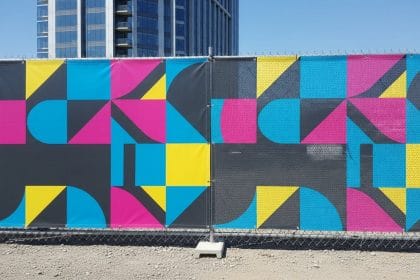
The efficacy of these displays lies in the thousands of tiny perforations distributed across the weave. These holes act as a pressure-relief valve for wind load, which is critical for signage attached to scaffolding, temporary fences, or high-elevation building wraps. While Vinyl banner materials are generally resilient, the mesh variant is the only choice for aerodynamic stability. There’s a calculated trade-off between airflow and image opacity, but for displays viewed from more than ten feet away, the human eye naturally “fills in” the gaps. This results in a professional, solid-looking graphic that won’t buckle under pressure.
Weather Resistance Beyond Wind
Survival in the elements involves more than just resisting gusts. In 2026, premium mesh banners utilize advanced UV-resistant inks that are chemically bonded to the PVC-coated polyester. This prevents the sun-fade that often plagues cheaper alternatives, ensuring your brand colors stay punchy for up to two years of direct exposure. The material’s waterproof nature prevents mold and mildew buildup, while its thermal stability ensures it won’t crack in sub-zero temperatures or stretch during a record-breaking heatwave. You aren’t just buying a print; you’re investing in a weather-hardened asset that maintains its prestige through every season.
Material Specifications: Choosing the Right Mesh Weight and Weave
Selecting the appropriate material grade is a critical decision that impacts both the longevity and the safety of your outdoor display. While the 70/30 airflow ratio provides the foundation for performance, the internal architecture of the fabric, measured by its denier count, determines its ultimate survival in the field. Denier refers to the linear mass density of the fibers; higher denier counts signify thicker, stronger yarns that enhance the banner’s tensile strength. Understanding how these materials react to aerodynamic loads on porous signs allows for more precise project planning, especially when mounting graphics in high-velocity wind zones.
Standard 8 oz Mesh: The Versatile Workhorse
The 8 oz variant is the most frequent choice for temporary installations like construction fence wraps and festival branding. Its popularity stems from an ideal weight-to-strength ratio. It’s light enough for rapid deployment by small crews yet strong enough to withstand the typical gusts found at ground level. For short-to-medium term projects lasting six to twelve months, this material provides a cost-effective solution that doesn’t compromise on professional aesthetics. It’s the go-to option for portable signage that needs to be moved or stored frequently without sacrificing structural integrity.
Premium 12 oz Mesh: Engineering for the Long Haul
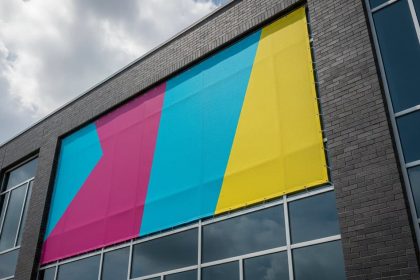
When the project moves to high-elevation building wraps or permanent stadium branding, the requirements shift toward the 12 oz heavy-duty mesh. This material features a tighter weave and higher denier count, providing superior tear resistance and a more substantial “pop” for high-resolution graphics. Because it’s denser, it offers slightly more opacity, making the colors appear more saturated from a distance. Compared to standard vinyl, this premium mesh offers the same professional finish but with the aerodynamic stability required for high-exposure environments. It’s built to resist the constant vibration and tension found in high-rise installations.
For specialized applications where graphics must be visible from both sides, block-out mesh banners utilize a specialized three-layer construction. This prevents light from washing out the imagery, ensuring your branding remains crisp even in direct, harsh sunlight. If you’re planning a high-visibility project, choosing the right material grade ensures your investment stays secure and visually striking. Our team can help you navigate these technical choices when you explore our specialized outdoor signs tailored to your specific site conditions.

Mesh Banners vs. Traditional Vinyl: Making the Right Choice
Deciding between solid vinyl and mesh requires a strategic understanding of your installation’s specific environment. While solid vinyl offers 100% opacity and unmatched detail for close-up inspection, mesh banners provide the aerodynamic transparency necessary for survival in open spaces. If you’re mounting a display directly against a solid brick wall, traditional vinyl is often the superior choice for maximum color saturation. However, for any application where the banner stands alone, such as on a chain-link fence or between poles, the semi-transparent nature of mesh becomes its greatest asset. For a deeper dive into the strengths of solid materials, you can consult the ultimate guide to professional vinyl banners.
Weight plays a pivotal role in project logistics and overall safety. Mesh is significantly lighter than standard 13 oz or 18 oz solid vinyl. This reduction in mass translates to lower shipping costs and a much faster installation process. A two-person crew can often handle a large-scale mesh project that would require three or four people for solid vinyl. This efficiency doesn’t just save time; it reduces the physical strain on your mounting structures, from grommets to zip ties, ensuring the display remains taut and professional throughout its lifespan.
Environmental Selection Criteria
The choice often boils down to exposure and risk management. In wide-open areas like parks, sports fields, or construction sites, wind has no natural barriers. Solid vinyl acts as a sail in these conditions, creating a high risk of structural failure or damage to the fence itself. High-elevation mounting on skyscrapers or scaffolding presents even greater danger; in these scenarios, mesh is the only safe, professional option. Local municipalities often have specific regulations regarding the “wind load” of outdoor signage. Mesh typically meets these safety standards with ease, allowing you to bypass potential compliance headaches.
The “Blurry” Myth: Managing Visual Expectations
Clients often worry that the perforations in mesh banners will make their graphics look blurry or washed out. Up close, at five feet, you’ll certainly see the weave of the material. However, from a viewing distance of 50 feet or more, the human eye naturally compensates for the holes, blending the printed dots into a cohesive image. To maximize this effect, we recommend using high-contrast colors and bold typography. Avoid delicate thin lines or small text, as these can visually dissolve into the mesh pattern. Large, punchy logos and saturated backgrounds ensure your brand remains unmistakable from across the street, maintaining the prestige your project deserves.
Best Practices for Designing and Installing High-Impact Mesh Graphics
Executing a successful project goes beyond material selection; it requires a specialized approach to graphic composition and structural reinforcement. Precision is your best ally here. Because mesh banners feature a perforated weave, your design must account for the 30% loss of surface area discussed in previous sections. This means fine lines, delicate serifs, and subtle gradients often vanish when viewed from a distance. To maintain brand prestige, stick to bold, sans-serif typography and high-saturation color palettes that command attention even when backlit by the sun.
Designing for the Perforated Surface
Color theory for mesh is unique. We’ve found that dark, high-contrast backgrounds generally perform better because they minimize the “see-through” effect caused by bright sky or reflective building surfaces. Vector graphics are essential for this scale. While high-resolution raster images work, vector files ensure your logos remain crisp as they’re scaled up to building-wrap proportions. If your display will be positioned in a spot where it’s frequently backlit, increasing the ink density or choosing darker hues will help maintain image clarity and prevent the graphic from looking washed out. Avoid busy patterns that compete with the material’s weave; simplicity is the key to legibility.
Installation and Mounting Safety
The durability of your display is only as good as its weakest mounting point. While competitors might suggest grommet spacing every 18 inches, professional commercial standards dictate the “Every 12 Inches” rule. This tighter distribution of tension prevents the material from sagging or tearing at individual points during heavy gusts. For the edges, heat-welded hems provide a superior bond compared to sewn alternatives, as they fuse the material layers into a single, high-strength unit. We recommend integrating reinforced webbing, which is a high-tensile internal strip, within the hem for any project located in a high-wind zone. For a comprehensive walkthrough of these techniques, our guide on how to install mesh banners for high-wind security covers the exact grommet spacing, hardware selection, and reinforced hem strategies used by professional installers.
Hardware selection is equally critical for a safe installation. Heavy-duty zip ties are excellent for quick fence mounts, but bungee cords offer a “shock absorber” effect that reduces the sudden snap of wind loads. For high-elevation or permanent displays, aircraft cable provides the ultimate tension and security. Proper mounting for outdoor signs prevents structural damage to both the banner and the host site. If you’re ready to secure your site with engineered signage, you can explore our professional outdoor display solutions to get started today.
Scaling Your Brand: Professional Mesh Printing Solutions
Executing a single banner is a straightforward task; managing a regional or national branding rollout is a strategic operation. Image Square Printing acts as a proactive partner for firms that require more than just a product. We provide a sophisticated infrastructure designed to handle complex, large-format projects with quiet confidence. Scaling mesh banners across multiple high-stakes construction sites or event venues requires a master craftsman’s attention to detail and a tech-forward approach to logistics. Our role is to remove the friction from the production process, allowing you to focus on high-level strategy while we handle the technical execution.
The value of a professional partnership begins long before the printer starts. Our pre-press services are a critical checkpoint where we optimize your files specifically for the 70/30 mesh weave. This ensures that your brand’s visual integrity remains intact, even on a perforated surface. For large corporate accounts and marketing agencies, we offer dedicated corporate portals that streamline multi-location orders. This system ensures consistency in color and quality across every site, regardless of the project’s scale. When timelines are tight, our national shipping capabilities ensure that your materials arrive on schedule, maintaining the momentum your industry demands.
The Image Square Advantage
We utilize high-resolution printing technology that bonds ink to the material at a molecular level. This results in mesh banners that maintain their prestige under the harshest UV exposure. Our collaborative design support works alongside your team to ensure every vector and color choice translates perfectly to the final medium. We don’t settle for standard retail finishing; our heat-welded hems and reinforced webbing exceed industry durability standards, giving you peace of mind that your display is secure.
Beyond the Banner: Integrated Visual Solutions
A cohesive brand experience often requires a multi-layered approach to signage. You can easily pair your outdoor mesh displays with high-impact retractable banner stands for indoor VIP areas or press check-ins. For event branding that demands a polished photo opportunity, step and repeat backdrops provide a professional logo wall solution that looks flawless under 4K lenses and social media scrutiny. For supplementary directional signage or site-specific safety notices, utilizing PVC and styrene signs provides a consistent, professional look that reinforces your brand’s authority. When your project demands the architectural rigidity and high-resolution graphic fidelity of rigid substrates, PVC signs offer a durable, professional branding solution that lighter materials simply cannot match. This integrated approach ensures that every touchpoint, from the perimeter fence to the interior booth, reflects the same level of quality. Ready to start? Get a custom quote for your mesh banner project today and let us bring your vision to life with precision and speed.
Engineered for Performance: Securing Your Brand’s Future
Mastering the physics of the 70/30 weave and selecting the correct material weight are the first steps toward a durable outdoor presence. The transition from standard vinyl to high-performance mesh banners is more than a simple choice; it’s a strategic move to protect your structural assets and maintain brand prestige in high-wind environments. By combining bold design principles with engineered finishing techniques like reinforced webbing, you ensure your message remains clear and secure throughout its entire lifespan.
Your high-stakes projects deserve the precision of a master craftsman. At Image Square Printing, we provide the technical infrastructure to scale your vision, from professional pre-press file optimization to streamlined corporate portal management for multi-location rollouts. Whether you need heavy-duty construction wraps or time-sensitive event signage, our national shipping ensures your brand arrives on time and in perfect condition. Order Your Custom Mesh Banners from Image Square Printing to experience a seamless production process tailored to the demands of modern business. We’re ready to bring your most ambitious visual challenges to life with reliability and speed.
Frequently Asked Questions
Are mesh banners see-through?
Mesh banners are semi-transparent because of their engineered 70/30 perforation ratio, which allows 30% of light and air to pass through the material. While the graphics appear solid from a viewing distance of 50 feet or more, you’ll notice the weave when standing closer. This transparency increases when the banner is backlit by strong sunlight, but it’s this exact feature that provides the aerodynamic stability required for high-wind environments.
How long do mesh banners last outdoors?
High-quality mesh banners typically last two years or more under direct sun exposure when printed with UV-coated inks. Their actual lifespan depends on the local climate and the precision of the installation. Because the material allows wind to pass through rather than pulling against the mounting hardware, it experiences less physical stress than solid vinyl, which prevents the grommets from tearing out prematurely during heavy storms.
Can you print on both sides of a mesh banner?
Double-sided printing is possible but requires a specialized block-out mesh material to maintain image legibility. Standard mesh is too porous for double-sided use as the light would cause the images from both sides to overlap and blur together. If your project demands visibility from both directions, we utilize a three-layer construction that maintains high-resolution clarity on both faces while still allowing for the necessary airflow through the fabric.
What is the best way to clean a mesh banner?
The most effective way to clean your banner is by using a soft cloth or sponge with mild soap and lukewarm water. You should avoid abrasive chemicals, power washers, or stiff brushes, as these can damage the UV-resistant ink layer and the PVC coating. Gently wiping the surface removes dust and environmental pollutants, keeping the colors vibrant and the perforations clear of debris for optimal performance and visibility.
Do mesh banners need wind slits?
Mesh banners do not require additional wind slits because the thousands of microscopic perforations already act as an integrated pressure-relief system. Cutting slits into mesh can actually compromise the structural integrity of the weave and lead to premature fraying or tearing. The material’s engineered airflow ratios provide superior aerodynamic stability without the need for unsightly manual modifications that would otherwise disrupt your graphic’s professional visual impact.
What is the difference between 8 oz and 12 oz mesh?
The primary difference lies in the material’s weight and tensile strength. Standard 8 oz mesh is the versatile choice for temporary events and construction fences where portability and ease of installation are key. In contrast, 12 oz heavy-duty mesh features a higher denier count and a tighter weave, making it the professional standard for long-term commercial installations, stadium wraps, and high-elevation building displays where maximum tear resistance is essential.
How do I hang a mesh banner on a fence safely?
To hang a banner safely on a fence, you must utilize every grommet provided, ideally following the commercial standard of 12-inch spacing. We recommend using heavy-duty zip ties for a taut finish or bungee cords to provide a shock-absorbing effect against sudden gusts. For large-scale displays, always ensure the host structure is sound and consider using reinforced webbing in the banner’s hems to distribute tension evenly across the mounting surface.
Can mesh banners be used indoors?
Mesh banners are an excellent choice for indoor environments, particularly in large venues like gymnasiums or theaters where acoustic transparency is beneficial. The material’s unique texture provides a sophisticated, modern aesthetic that works well for hanging displays or room dividers. Because they are lightweight and meet NFPA 701 flame propagation standards, they are a safe and stylish solution for high-traffic public spaces, corporate events, and trade show backdrops.