
Did you know that a single poorly placed logo or an overlooked glossy finish can turn a high-stakes media event into a branding disaster? Most professionals believe a red carpet moment is just about the celebrity, but it’s actually the result of calculated geometric precision and light-management science. When you design step and repeat backdrops for the 2026 event landscape, you aren’t just making a sign; you’re engineering a stage that must survive the scrutiny of high-resolution cameras and aggressive flash photography.
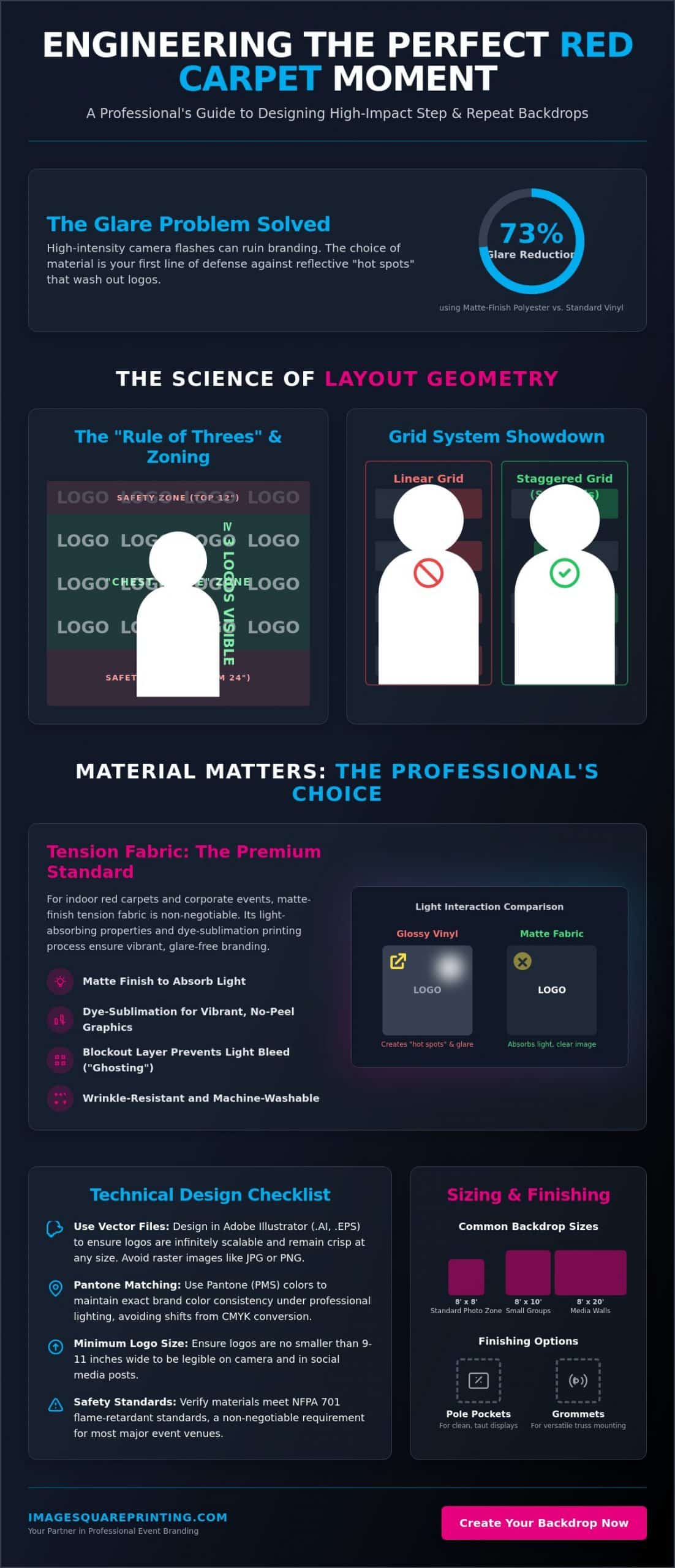
We understand the frustration of seeing your brand identity compromised by pixelated graphics or ruined by distracting camera glare. You want a backdrop that reflects your prestige, not one that looks like a budget afterthought. This guide will teach you the professional design principles, logo geometry, and material science required to create red-carpet-ready displays that elevate your brand. We’ll explore technical specifications for the latest Adobe Illustrator 29.8.7 workflows, the benefits of matte-finish polyester which reduces glare by 73% compared to vinyl, and the non-negotiable NFPA 701 safety standards required by major venues.
Key Takeaways
- Master the geometric “Rule of Threes” to ensure your logos are perfectly sized for maximum visibility without cluttering the visual pattern.
- Discover why matte finishes are non-negotiable for high-end events and how to choose between tension fabric and premium vinyl for different lighting environments.
- Learn the technical requirements to design step and repeat backdrops using vector files and Pantone matching for flawless, high-resolution brand consistency.
- Identify the ideal backdrop scale for your specific event, from the standard 8 foot photography zone to expansive 20 foot media walls for large group shots.
- Enhance the longevity and professional presentation of your project with finishing options like pole pockets and grommets designed for rapid, high-pressure setups.
The Science of Logo Spacing and Layout Geometry
Before you open your design software, you must understand that What is a Step and Repeat Backdrop? is more than a simple repeating pattern. It’s a strategic grid engineered to ensure your brand remains visible regardless of where a subject stands. When you design step and repeat backdrops, your primary goal is to eliminate “dead spots” where a person’s head or torso might completely obscure the branding. Effective layouts anticipate the camera’s crop, keeping logos within the frame for both wide group shots and tight solo portraits.
We recommend the “Rule of Threes” for standard 8-foot heights. This principle dictates that you should have at least three visible logos vertically behind a person of average height. You must also account for the “Safety Zone.” The top 6 to 12 inches often house the hardware’s crossbar or suffer from downward-facing venue lighting shadows. Conversely, the bottom 18 to 24 inches are frequently blocked by the subjects’ legs or floor-level shadows. Concentrate your high-value branding in the “Chest to Eye” zone, typically between 3 feet and 6 feet from the ground.
Logo Sizing and Aspect Ratio Harmony
Mixing a tall, vertical logo with a wide, horizontal one creates visual chaos if not handled with geometric precision. To standardize these disparate shapes, we create a “containment box” for each grid position. For maximum legibility on camera, a logo should rarely be smaller than 9 to 11 inches wide. If you use smaller graphics, they’ll disappear into a blurry texture in the background of social media posts. Consistent negative space, or padding, is your best tool here. It ensures each brand has room to breathe, preventing the “cluttered wall” look that diminishes brand prestige.
The Staggered Grid vs. Linear Alignment
Linear grids often fail in professional photography. If subjects stand slightly to the left or right, they can easily block an entire vertical column of logos. A staggered or “offset” grid solves this by shifting every other row by 50%. This ensures that even if a subject blocks one logo, the logos in the rows above and below remain visible. This strategy is the gold standard when you design step and repeat backdrops for high-traffic media walls. This layout is especially critical for large format printing in Santa Monica and Los Angeles, where events demand foolproof visibility. For events with a primary sponsor, use “anchor logos” that are 15% to 20% larger than the secondary logos to establish a clear hierarchy within the staggered pattern.
Material Selection: Solving the Glare and Durability Challenge
Choosing the right material is as critical as the layout geometry discussed in the previous section. While the math of the grid ensures logo visibility, the physics of light determines whether those logos actually translate to a digital sensor or film. When you design step and repeat backdrops, you must prioritize light absorption over reflection. High-intensity camera flashes and overhead venue lighting create a hostile environment for branding. A glossy surface acts like a mirror, creating “hot spots” that can completely wash out your brand identity in the final image.
Many institutional standards, such as the University Design Specifications, emphasize the importance of matte finishes to maintain brand integrity under press lighting. Beyond glare, you have to consider light opacity. If your backdrop is placed in front of a window or a bright exit sign, “ghosting” can occur, where the background light bleeds through the material and muddies your graphics. Professional-grade materials include a blockout layer to ensure your logos remain crisp and punchy, regardless of what’s happening behind the stand.
Tension Fabric: The Premium Event Standard
Tension fabric has become the gold standard for indoor red carpets and corporate galas. Research shows that matte-finish polyester fabric backdrops reduce photo glare issues by 73% compared to standard vinyl options. This material utilizes dye-sublimation printing, a process where ink is heat-fused directly into the fibers. The result is a vibrant, no-peel finish that won’t crack when folded. These fabrics are also machine-washable, which provides a much higher ROI for brands with a multi-city event calendar. For smaller, portable activations, you can see how these high-end materials compare to fabric posters, which offer similar anti-glare benefits on a smaller footprint.
Matte Vinyl: Durability for High-Traffic Environments
For outdoor festivals or high-traffic environments where spills and weather are factors, 13oz scrim vinyl remains a reliable workhorse. It’s a cost-effective solution for single-use high-impact branding, provided you specify a matte finish. Vinyl is naturally opaque, making it the ideal choice for preventing background shadows in bright environments. It’s also incredibly easy to clean with a simple damp cloth, which is a major benefit for food-focused events. You might want to compare these with professional outdoor signs if your activation requires long-term exposure to the elements beyond a single weekend.
If you’re planning a high-visibility event and need a solution that combines technical precision with rapid delivery, our team specializes in trade show displays and media walls that meet these exacting standards.
Choosing the Right Scale: Sizing and Hardware Frameworks
Scale is the foundational element that dictates the success of your event’s visual output. If a backdrop is too narrow, the photography hardware will bleed into the edges of every guest photo. If it’s too large for the venue, it creates logistical friction during the high-pressure setup window. When you design step and repeat backdrops, you’re essentially defining the boundaries of the media “stage.” The 8′ x 8′ dimensions have become the industry’s “goldilocks” zone because they perfectly match the standard aspect ratio of professional DSLR sensors and mobile social media frames.
Selecting the correct dimensions requires an understanding of your expected guest density. A standard 8′ x 8′ unit accommodates up to 4 or 5 people comfortably. If your event involves larger groups or corporate team photos, moving to a 10′ width is essential to provide coverage for 5 to 6 individuals. For high-profile press conferences or red carpet arrivals with significant media presence, 15′ to 20′ walls are the professional standard. This expansive scale ensures that your Branding for Events remains the dominant visual element, even when photographers are forced to use wide-angle lenses to capture large groups.
Sizing Guide by Guest Capacity
- 5′ to 8′ Widths: These are engineered for solo portraits, influencer activations, or tight vertical frames favored by TikTok and Instagram Stories.
- 10′ Widths: This is the strategic sweet spot for couples and small groups of 3 to 4 people, ensuring the branding isn’t cut off at the shoulders.
- 15′ to 20′ Widths: These massive media walls are built for wide-angle media scrums, allowing 6 to 8 people to stand in a single row without losing brand visibility at the edges.
Hardware Engineering and Setup
Stability is a non-negotiable requirement for professional environments. Telescopic stands offer the greatest versatility for height and width adjustments, but they require precise leveling to prevent a tilted appearance. For a more architectural look, pop-up “accordion” frames provide a rigid structure that is incredibly fast to deploy. These frames are particularly effective when paired with tension fabric, as they pull the material taut to achieve a “drum-tight” finish. This prevents the sagging or ripples that can distort your logo geometry. For those seeking modular, high-impact solutions, our trade show displays offer integrated hardware systems that prioritize both durability and solo-setup capabilities.
Portability factors shouldn’t be an afterthought. A high-end hardware system should utilize lightweight aluminum components and include a reinforced padded carrying case. This ensures your investment survives the rigors of transit while remaining easy enough for a single team member to assemble in minutes, reflecting the efficiency required in modern event production.
Technical Design Specifications for High-Resolution Output
Precision in the design phase is what separates a world-class media wall from a pixelated disaster. When you design step and repeat backdrops, you must abandon the low-resolution workflows typical of web design. Vector files are your only insurance against blurriness. Formats like .AI, .EPS, or .SVG use mathematical paths rather than pixels, which means they can scale to an 8-foot or 20-foot width with zero loss in clarity. If you’re working in the latest Adobe Illustrator 29.8.7, ensure your artboards are set to the exact final output size to avoid any scaling math errors during the pre-press stage.
Resolution requirements for large format differ significantly from standard commercial print. We recommend a resolution of 150 DPI at 100% scale. While 300 DPI is the rule for business cards, it’s overkill for an 8-foot print and results in unnecessarily bloated files. You must also account for bleed and margin setup. Keep all critical branding elements at least 2 inches away from the edges. This “safe zone” prevents your logos from being caught in the stitching of a pole pocket or obscured by the grommets used for tensioning.
Pre-Press Checklist for Designers
- Convert fonts to outlines: Never ship a file with live text. Converting to outlines ensures your brand’s specific typography remains intact, even if the production environment lacks your specific font files.
- Achieve a Rich Black: On tension fabric, a simple 100% K black often appears as a washed-out charcoal. Use a “Rich Black” formula, such as C60 M40 Y40 K100, to ensure a deep, light-absorbing finish that makes your logos pop.
- Audit for transparency: Zoom in to 400% to verify that your logos don’t have “white box” artifacts. These stray pixels become glaringly obvious when printed at a large scale.
Proofing and Color Accuracy
Color perception changes based on the medium and the environment. A logo that looks perfect on a backlit LED monitor will shift when printed on matte polyester. To maintain brand integrity, you should always reference Pantone (PMS) Matching System values. This allows us to calibrate our dye-sublimation equipment to your exact corporate colors. Remember that venue lighting also plays a role; warm incandescent bulbs will shift your colors differently than cool-toned stage LEDs. You can learn more about large format poster printing standards to understand how resolution and color management apply across different high-impact media. If you’re ready to ensure your brand’s next event is flawless, contact our technical team for a professional file audit.
Professional Printing and Finishing: The Image Square Difference
The transition from a high-resolution vector file to a physical red-carpet centerpiece requires more than just a printer; it demands a master craftsman’s eye for detail. When you design step and repeat backdrops, the digital layout is only the first half of the project. The physical execution, specifically the finishing and hardware integration, determines how the backdrop performs under the high-pressure environment of a live media event. We treat every project as a collaborative partnership, ensuring that the technical precision of your design is matched by the physical quality of our output.
Quality control at this scale involves rigorous color verification and material inspection. Because we understand the demanding standards of modern business, we ensure every fabric backdrop meets NFPA 701 fire safety regulations, a non-negotiable requirement for major U.S. convention centers in 2026. Our production process is built for speed and reliability, mirroring the rapid timelines of the industries we serve. Whether you’re preparing for a sudden press announcement or a scheduled gala, our local presence in a major metropolitan hub allows us to deliver premium solutions while others are still processing the order. For a deeper look at how 2026 event trends are reshaping display standards, our definitive guide to step and repeat backdrops and event branding in 2026 covers the shift toward minimalist luxury and silicone edge systems in detail.
Finishing for Impact
The longevity of your display depends on the quality of its edges and anchor points. We offer a variety of professional finishing options tailored to your specific installation needs. For tension fabric systems, hemmed edges are mandatory to prevent fraying and ensure a clean, architectural finish. If your event requires a traditional pipe-and-drape setup, we provide reinforced pole pockets that distribute weight evenly, preventing the sagging that can ruin your logo geometry. For high-wind outdoor environments, reinforced corners and strategically placed grommets allow for the high-tension installation required to keep your branding visible and stable. We can even provide custom die-cutting for brands looking to break away from the standard rectangular frame with unique, contoured shapes.
The Collaborative Production Partner
We don’t just print files; we solve business challenges. Our team provides direct access to experts who can help optimize your layout for the best photographic results. To create a fully immersive brand experience, consider integrating your backdrop with floor graphics or side-wing signage, creating a three-dimensional media “stage” that captures attention from every angle. With our capability for national shipping and fulfillment, we can support multi-city event tours with consistent quality across every location. We remove the friction from the production process, allowing you to focus on the event itself while we handle the technical execution. Design your professional step and repeat backdrop with Image Square Printing today.
Elevate Your Brand with Red-Carpet Precision
Designing a high-impact media wall requires a sophisticated blend of geometric layout and technical material selection. By mastering the Rule of Threes and prioritizing matte-finish tension fabrics, you ensure your brand remains the focal point of every photograph. As you design step and repeat backdrops for your upcoming activations, remember that successful execution depends on precise pre-press standards. This includes the use of vector files and rich black color profiles to maintain brand integrity under intense, high-stakes event lighting.
Since 2003, Image Square Printing has leveraged over 20 years of expertise to transform digital visions into physical red-carpet reality. We utilize high-resolution dye-sublimation printing to deliver vibrant, glare-free finishes that meet the demanding standards of modern corporate events. Every project we handle includes professional pre-press file optimization to guarantee your logos are sharp, properly scaled, and perfectly aligned for the camera.
Don’t leave your brand’s visibility to chance. Order Your Custom Step and Repeat Backdrop Today and experience the reliability of a master craftsman. Your brand deserves a stage that reflects its prestige and captures the attention it has earned.
Frequently Asked Questions
What is the best material for a step and repeat backdrop?
Matte-finish polyester fabric is the superior choice for indoor events because it reduces photo glare by 73% compared to vinyl. This material absorbs light instead of reflecting it, ensuring your logos stay visible under aggressive flash photography. While 13oz scrim vinyl is durable for outdoor use, tension fabric provides the premium, wrinkle-free look required for high-stakes red carpets and corporate galas.
How many logos should I include on a step and repeat banner?
You should aim for a balanced pattern that places at least three logos vertically behind a subject of average height. When you design step and repeat backdrops, the goal is a staggered grid where logos are spaced roughly 8 to 12 inches apart. This density ensures that your brand is always visible in the frame, even when multiple guests are standing in front of the display.
What size step and repeat do I need for a group of 5 people?
An 8’x8′ backdrop is the minimum requirement for a group of 5 people, but a 10’x8′ size is the professional recommendation for maximum comfort. According to industry standards, an 8’x8′ unit typically accommodates 4 to 5 people in a single row. Moving to a 10-foot width provides the extra buffer needed to prevent guests from “bleeding” off the edges of the branded area in wide-angle shots.
How do I prevent glare on my backdrop in event photos?
Choosing a matte finish is the most effective way to eliminate distracting reflections in your event photography. Glossy surfaces act like mirrors, creating hot spots that wash out your brand identity. Using tension fabric or matte-finish vinyl ensures that light from camera flashes is diffused across the surface. This is a critical step when you design step and repeat backdrops for press-heavy environments where lighting is unpredictable.
Can I wash a fabric step and repeat backdrop?
Yes, high-quality polyester tension fabric backdrops are machine-washable and can be tumbled dry on low heat. Because the dye-sublimation process bonds the ink directly into the fibers, the graphics won’t peel or fade during a standard wash cycle. This makes fabric a high-ROI investment for brands that need a clean, professional look across a multi-city event tour or a long-term trade show schedule.
What file format is best for printing large backdrops?
Vector formats like .AI, .EPS, or .SVG are mandatory to ensure your logos remain sharp when scaled to eight feet or larger. Unlike JPEGs, vector paths don’t pixelate when resized. For the best results, your design files should be set to 150 DPI at 100% of the final print size. This technical precision ensures your hardware displays the crisp, high-DPI output required for modern high-resolution cameras.
How long does it take to set up a standard step and repeat stand?
A standard telescopic stand or pop-up accordion frame typically takes 10 to 15 minutes for a single person to assemble. These systems are engineered for rapid deployment in fast-paced event environments. Most professional kits utilize lightweight aluminum components and tool-free assembly. This allows your team to move quickly from the loading dock to a fully tensioned, red-carpet-ready display without the need for specialized technical support.
Do you offer design services if I only have my logos?
Yes, we provide professional pre-press file optimization and layout support as part of our collaborative production process. If you provide your high-resolution logos, our technical team can engineer the geometric grid and offset patterns required for maximum visibility. We act as a proactive partner to ensure your vision translates perfectly to the final medium, removing the friction from the ordering process for busy marketing teams.