
Can a material as lightweight as foam core boards actually carry the weight of a premium brand identity in a high-stakes Los Angeles environment? You’ve likely felt the frustration of seeing a vibrant design undermined by a dented corner or a warped edge during transit. It’s a common challenge for marketing teams who demand high-resolution impact but need to stay agile. As 2026 brings new regulatory shifts like the Farewell to Foam Act, selecting the right professional substrate is now a matter of both visual prestige and strategic compliance.
We understand that you need reliability when your brand is on the line. This guide helps you master the technical specifications and professional applications needed to elevate your brand’s visual presence with confidence. We’ll show you how to distinguish between standard retail products and the high-end, custom solutions we produce for the most demanding industries. You will learn the exact board specs required for your next event, the crucial differences between foam and Gatorboard, and how to ensure your image resolution remains crisp on any large-format display.
Key Takeaways
- Learn why material density is the secret to superior ink absorption and long-lasting structural integrity for your professional displays.
- Identify the specific thickness required for your project, from agile 1/8″ panels to heavy-duty 1/2″ foam core boards designed for maximum rigidity.
- Compare foam core against Gatorboard and PVC to select the optimal substrate based on your event’s durability and environmental needs.
- Explore professional use cases that turn standard slide decks into high-impact boardroom presentations and easy-to-install retail branding.
- Understand the technical requirements for high-DPI files and UV printing to ensure your graphics remain vibrant and scratch-resistant at large scales.
What are Foam Core Boards? Understanding the Professional Substrate
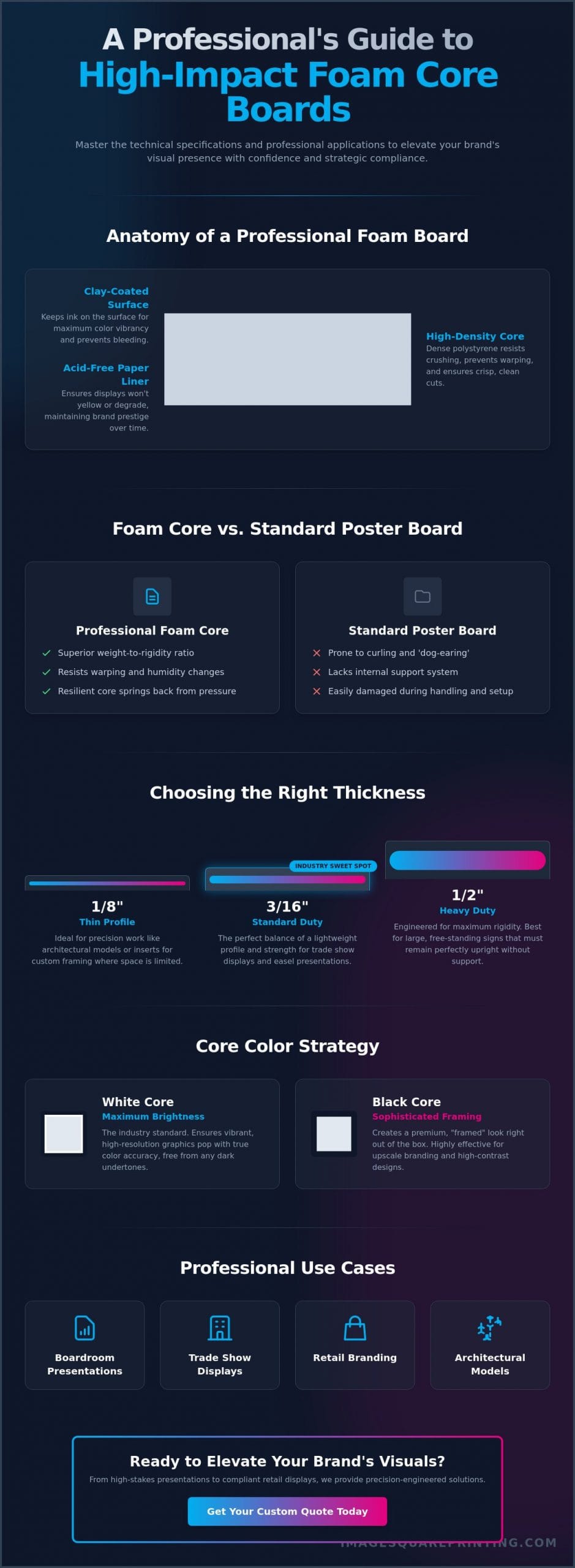
Professional foam core boards are not just simple display panels. They represent a precision-engineered substrate designed for high-impact visual communication. As a master craftsman in the printing industry, I look at these boards through the lens of material science. The dense polystyrene foam core, sandwiched between two layers of matte paper, dictates how the final image will sit on the surface. High density prevents the ink from causing the paper to swell or warp; this maintains a perfectly flat plane that catches light evenly. This reliability is why brands in 2026 prioritize this material for temporary but high-visibility storytelling, especially in fast-paced retail or corporate environments.
Anatomy of a Professional Foam Board
The performance of Foamcore depends entirely on its internal composition. We emphasize high-density polystyrene because it prevents the crushing effect that occurs with cheaper retail alternatives. When we cut these boards to size, the core must resist the blade to produce a crisp, professional edge. The outer liners are equally vital for visual impact. Professional boards often feature clay-coated surfaces that act as a barrier, keeping the ink on the surface for maximum vibrancy rather than letting it bleed into the core. Additionally, the acid-free nature of these liners ensures that your high-stakes displays won’t yellow or degrade over time, maintaining brand prestige for the duration of your campaign.
Foam Core vs. Standard Poster Board
The difference between these two materials is immediately apparent in their structural behavior. Standard poster board lacks an internal support system, making it prone to curling or dog-earring as environmental humidity fluctuates. In contrast, foam core boards provide a superior weight-to-rigidity ratio that is essential for large format poster printing. This rigidity ensures your message remains upright and impactful on an easel or mounted to a wall without the unsightly sagging associated with thinner stocks. The polystyrene core possesses a distinct memory that allows the material to spring back to its original shape after enduring light surface pressure. This resilience is a key differentiator, ensuring that minor handling during an event setup doesn’t result in permanent damage to your visual presentation.
Technical Specifications: Sizing, Thickness, and Material Options
Success in professional visual communication hinges on technical precision. Selecting the wrong specifications for your foam core boards can lead to structural failure or a visual aesthetic that doesn’t meet your brand’s standards. While generic retailers offer limited selections, a professional production partner provides a spectrum of options engineered for specific environments. We utilize oversized panels up to 48″ x 96″, allowing for seamless, large-format graphics that command attention in any setting. This scale is vital for high-visibility projects where a segmented display would compromise the integrity of your design.
Choosing the Right Thickness for Your Project
Thickness is the primary driver of rigidity and durability. The 3/16 inch option remains the industry sweet spot because it balances a lightweight profile with enough strength for most trade show displays and easel presentations. It’s the go-to choice for short-term events where portability is a priority. However, for projects requiring maximum rigidity, we recommend the 1/2 inch heavy-duty board. This thickness is ideal for free-standing floor signs that must remain perfectly upright without support. On the other end of the spectrum, the 1/8 inch thin profile is reserved for precision work, such as architectural modeling or inserts for custom framing where space is limited but flatness is paramount.
Color Strategy: White Core vs. Black Core
The core color of your board isn’t just a hidden detail; it’s a strategic design element. White core boards are the standard for maximizing brightness. They ensure that vibrant, high-resolution graphics pop without any dark undertones affecting the color accuracy. Conversely, black core boards create a sophisticated, “framed” look right out of the box. This option is particularly effective for premium branding where the side profile of the board is visible to the audience. It also serves a functional purpose by preventing light-bleed in backlit environments. This “sandwich” effect, the visible layer of the core between the printed surfaces, can significantly impact the perceived prestige of your brand. If you’re planning a high-pressure launch, our team provides expert guidance on large-format printing in Santa Monica and Los Angeles to ensure your material choices align with your creative vision.
Precision CNC routing allows us to move beyond standard rectangles. We can die-cut your boards into custom shapes, from logo silhouettes to life-sized standees. This level of customization transforms a simple sign into a dynamic brand asset that engages viewers more effectively than traditional static media. We don’t just print; we fabricate solutions that help you stand out in competitive markets.
Foam Core vs. Gatorboard vs. PVC: Choosing the Right Substrate
“Is foam core durable enough for my event?” This is the most frequent question we receive from marketing professionals. The answer depends entirely on the environment and the duration of your campaign. Foam core boards are the undisputed king of temporary commercial advertising because they deliver high-resolution visual impact at a fraction of the cost of denser materials. They provide a perfectly flat, rigid surface that doesn’t bow under its own weight; this is essential for short-term retail displays or one-day corporate presentations where visual prestige is required on a tight timeline.
When to Upgrade to Gatorboard
Permanent installations or high-traffic environments require a more resilient solution. This is where Gatorboard prints become the strategic choice. The structural difference lies in the surface. While foam core uses paper liners, Gatorboard uses a resin-impregnated fiber for extreme toughness. This wood-veneer surface resists the dents, scratches, and corner-crushing that can happen when boards are moved frequently across different venues. If your display needs to last for several months in a busy retail hallway or serves as a long-term office wall graphic, the structural upgrade is worth the investment. It maintains its integrity even when subjected to minor impacts that would leave a permanent mark on standard foam.
Foam Core vs. PVC and Styrene
Weight and environment are the deciding factors when choosing between foam and plastic-based substrates. PVC and styrene signs offer exceptional weather resistance and flexibility. However, that flexibility can be a drawback for large-format displays that need to stand on an easel. PVC tends to “smile” or bow over time if it isn’t properly supported. Foam core boards provide superior snap-resistance and stay perfectly flat without the need for extra backing hardware.
Ceiling-hung signage is another area where foam core excels. its feather-light weight reduces the stress on hanging hardware and simplifies installation for your on-site staff. You must remember that foam core is strictly for indoor or very short-term dry outdoor use. Exposure to moisture will cause the paper liners to delaminate. For any project facing the elements, PVC is the correct technical path — or consider aluminum signs engineered for long-term outdoor durability, which offer weather resistance and structural integrity for permanent installations. When your project demands a premium indoor presence, understanding the full spectrum of rigid sign materials is essential; our detailed comparison of acrylic vs aluminum signs can help you determine the right high-impact medium for your specific environment. Our team evaluates these variables to ensure you don’t overspend on durability you don’t need or compromise on a material that won’t survive the venue. We help you select the exact substrate that balances your budget with the high-stakes demands of your brand visibility.
Maximizing Brand Impact: Professional Use Cases for Foam Board Prints
Forget the misconception that foam core boards are limited to student projects. In the professional world, these substrates are high-impact tools for corporate boardrooms and retail environments alike. We transform digital slide decks into tangible, high-resolution panels that command attention during critical investor pitches. Physical boards allow presenters to point, gesture, and engage with data in a way that a projector screen simply cannot replicate. This tactile presence lends an air of authority and preparation to any executive presentation.
Retailers rely on these boards for Point-of-Purchase (POP) displays because they’re exceptionally easy to install. Your floor staff can swap out eye-level branding in seconds without specialized tools or hardware. This agility is crucial for Los Angeles brands that must pivot marketing messages based on weekly trends or local events. Beyond retail, professional wayfinding signage directs foot traffic at large-scale conventions, providing crisp, high-visibility instructions that prevent bottlenecks and enhance the attendee experience.
Events and Trade Shows
In the high-pressure environment of a convention center, rigidity is your best friend. Foam panels serve as excellent alternatives to traditional step and repeat backdrops when you need a perfectly flat, non-reflective surface for photography. You can create a sophisticated, layered booth design by combining these rigid panels with retractable banner stands. This combination adds depth to your space and allows you to highlight specific product features on the boards while the banners provide the high-level brand message. For more inspiration on elevating your presence, see our guide on 25+ creative foam core uses.
Retail and Interior Branding
Visual merchandisers use multi-layered foam core cutouts to create depth in window displays, drawing the eye of passersby with 3D effects. These boards also facilitate the classic “big check” for charity presentations, offering a lightweight yet sturdy prop for high-profile photo opportunities. For office environments, foam core offers a way to introduce dimensional branding without the long-term commitment or installation complexity of custom wall coverings. When you’re ready to make a more permanent statement, custom wall murals offer a high-impact solution that transforms entire interior spaces with large-format precision printing. It’s the perfect solution for seasonal graphics or temporary mission statements that need to look permanent but remain removable.
Ready to transform your visual strategy? Order your custom foam core boards from our Los Angeles facility today for rapid turnaround and professional quality.
Precision Production: The Image Square Printing Approach to Custom Foam Core
Production quality is the final bridge between a creative concept and a high-impact physical asset. While many vendors simply sell blank materials or use outdated mounting methods, we utilize advanced direct-to-substrate UV printing. This technology allows us to print your designs directly onto the surface of the foam core boards, ensuring the ink bonds instantly for a scratch-resistant and vibrant finish. In 2025, inkjet technology accounted for over 53% of the North American printed signage market; we lead this trend by using high-end equipment that eliminates the bubbling and peeling associated with traditional adhesive mounting.
Resolution isn’t just a technical detail; it’s the foundation of your brand’s credibility. We require high-DPI files because large-format displays amplify every imperfection. A logo that looks sharp on a laptop screen can appear pixelated when scaled to a 48″ x 96″ panel. Our team acts as a collaborative partner, reviewing your assets to ensure every line of text is crisp and every image remains high-resolution. To further enhance the visual impact, we offer professional finishing options including gloss, matte, and luster laminations. These coatings don’t just protect the surface; they deepen color saturation and eliminate glare in high-pressure environments like televised press conferences or bright retail showrooms.
File Preparation for Large-Format Success
Achieving a seamless finish starts with the digital file. We recommend a minimum of 0.125-inch bleed to ensure your graphics aren’t cut off during the precision trim process. For large format poster printing, the CMYK color profile is our standard to ensure the physical output matches your brand’s specific color requirements. While raster images are excellent for photography, we suggest using vector formats for logos and typography. Vectors allow for infinite scalability without loss of quality, which is essential when your branding needs to span the entire width of a convention booth.
Mounting and Installation Solutions
A professional board is only effective if it’s displayed correctly. We provide a variety of integrated mounting solutions that allow your team to set up in seconds. Easel backs are the most popular choice for instant, free-standing table-top signs. For office interiors or temporary gallery walls, we suggest damage-free options like Velcro or Command Strips. If you’re dealing with oversized panels or ceiling-hung signage, we can install professional hanging hardware, including grommets or cleat systems, to ensure a secure and level display. Our Los Angeles roots mean we understand the pace of local industries; we offer same-day production capabilities to meet the most demanding corporate deadlines. When your project requires large-format printing in Santa Monica or Los Angeles, we deliver the speed and precision your brand deserves.
Elevate Your Visual Presence with Precision Printing
Choosing the right substrate is a strategic decision that defines how your audience perceives your brand in high-stakes environments. You now understand how to balance material density and thickness to ensure your displays remain perfectly flat and impactful regardless of the venue. By leveraging the technical advantages of UV direct-to-substrate printing, you can achieve vibrant, scratch-resistant graphics that stand up to the fast-paced demands of Los Angeles business. This guide has provided the framework to move beyond retail-grade materials toward professional solutions that command respect.
We’ve spent years perfecting our craft as master printers. It’s the reason Fortune 500 brands trust us for their most critical trade show graphics and corporate presentations. Whether you need oversized panels for a convention or eye-level branding for a retail rollout, our high-resolution technology ensures every detail is captured with absolute clarity. We offer same-day turnaround for urgent projects because we know that in this industry, timing is just as vital as quality. Don’t leave your brand’s visual identity to chance when your reputation is on the line.
Order Custom Printed Foam Core Boards Today and experience the difference that professional-grade production brings to your next project. We’re ready to bring your vision to life with the precision it deserves.
Frequently Asked Questions
Can you print on both sides of a foam core board?
Yes, we can print high-resolution graphics on both sides of the substrate to maximize your brand’s visibility. This is an excellent choice for ceiling-hung signage in retail stores or double-sided directional displays at conventions. Double-sided printing ensures that your message reaches foot traffic from all directions without the need for extra mounting hardware or secondary boards.
How do I prevent my foam core boards from warping?
Preventing warping starts with proper storage and material selection. You should always store your boards flat in a climate-controlled environment to avoid the humidity fluctuations that cause paper liners to expand. For larger displays, we recommend choosing a 1/2 inch thickness. This added depth provides the structural rigidity necessary to keep the panel perfectly flat when it’s displayed on an easel or mounted to a wall.
Is foam core the same as foam board?
Yes, these terms are typically used interchangeably within the professional printing industry. “Foam core” specifically refers to the internal polystyrene center that gives the material its lightweight rigidity. Whether you request foam board or foam core boards, the result is the same: a smooth, flat surface engineered for vibrant UV printing and professional corporate presentations.
What is the largest size foam core board you can print?
We produce seamless, oversized panels up to 48″ x 96″ in a single sheet. This massive format is perfect for creating impactful retail backdrops or detailed wayfinding maps for large venues. If your project requires even larger dimensions, our craftsmen can precision-tile multiple boards together. This allows us to create expansive wall displays that maintain a cohesive, professional look across the entire surface.
Can foam core boards be used outdoors for events?
Foam core is strictly intended for indoor or very short-term dry outdoor use. Because the outer layers are made of paper, any exposure to rain, heavy dew, or high humidity will cause the material to swell and delaminate. For outdoor events, we recommend substrates like PVC or aluminum signs built to withstand the elements. These materials offer the weather resistance needed to survive the elements while maintaining your brand’s visual prestige.
How do I clean or maintain my printed foam boards?
Maintaining your boards is simple if you avoid liquids entirely. Gently wipe the surface with a dry, soft microfiber cloth to remove dust or light fingerprints. You should never use water or cleaning sprays, as moisture will soak into the paper edges and ruin the board. If you’ve opted for a lamination finish, the surface is more resilient, but a dry cloth remains the safest tool for preservation.
What is the best way to cut foam core without jagged edges?
Professional results require a CNC router to ensure perfectly smooth, burr-free edges on every cut. If you’re forced to make a minor adjustment on-site, use a brand-new X-Acto blade and a metal straightedge. Don’t try to cut through the entire board in one stroke. Instead, make several light passes to prevent the internal foam from tearing or compressing, which is the primary cause of jagged edges.
How long do foam core prints typically last indoors?
High-quality foam core prints can last for several years when they’re displayed in a stable, low-traffic indoor environment. Their lifespan depends largely on handling and environmental stability. While they’re a cost-effective solution for long-term office decor, they can be susceptible to corner damage if moved frequently. For permanent installations in high-traffic hallways, we often suggest upgrading to Gatorboard for its superior dent resistance. If you’re considering a truly permanent interior branding solution, explore how professionally printed wall murals can deliver lasting visual impact with exceptional durability.