
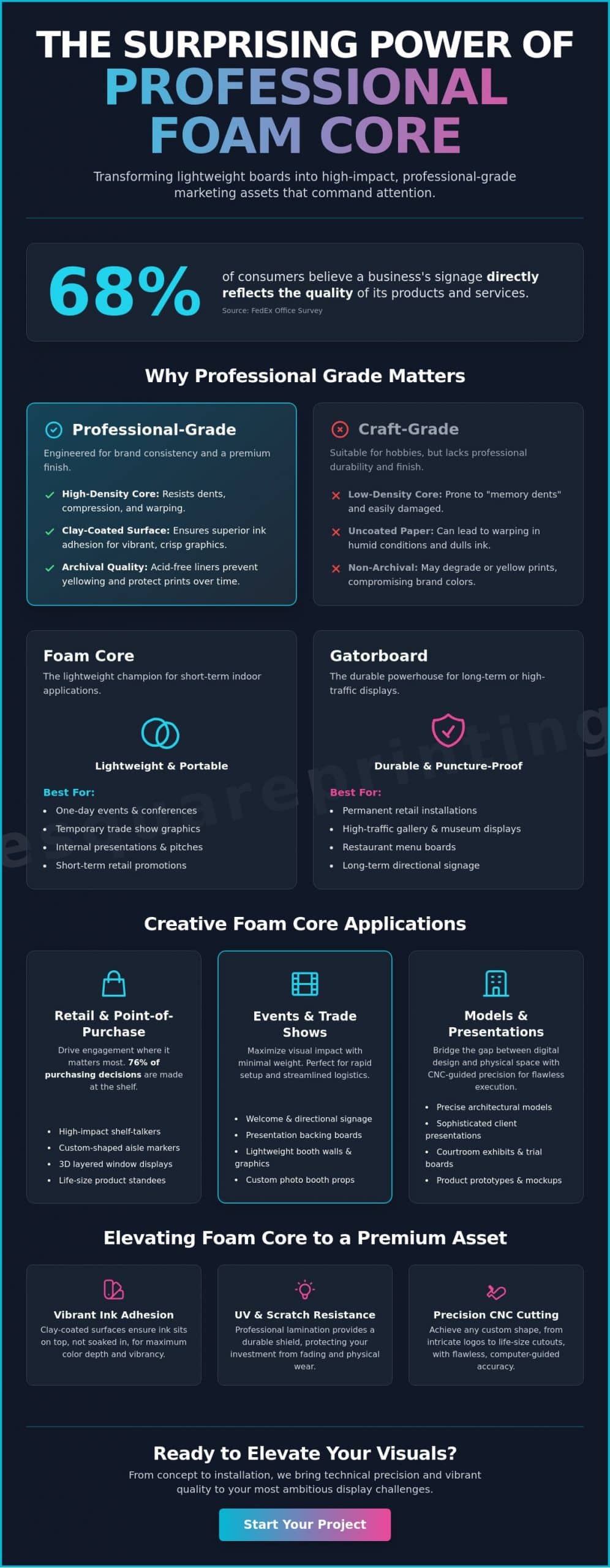
Can a material often dismissed as a basic craft supply actually anchor a high-stakes product launch in a city as competitive as Los Angeles? You likely agree that high-impact marketing usually demands a heavy budget and even heavier hardware. Finding a material that balances structural integrity with effortless portability often feels like a frustrating trade-off between quality and convenience. According to a landmark FedEx Office survey, 68% of consumers believe a business’s signage directly reflects the quality of its products and services. That is why mastering creative foam core uses is essential for any brand that needs to maintain a premium image on a fast-paced timeline.
We’ll show you how to transform this versatile substrate into professional-grade marketing assets that look like they cost ten times their actual price. Whether you need precise architectural models or vibrant, high-resolution retail displays, you don’t have to sacrifice visual impact for a budget-friendly solution. This guide previews 25+ sophisticated applications that turn standard foam core into bespoke event decor and durable brand touchpoints that command attention in any space. From custom shapes to seamless finishes, discover how we bring technical precision to your most ambitious display challenges.
Key Takeaways
- Distinguish between craft-grade and professional-grade materials to ensure your branding projects achieve a high-density, premium finish.
- Learn how to drive consumer engagement in retail environments by utilizing high-impact shelf-talkers and aisle markers that leverage purchasing psychology.
- Streamline your event logistics by discovering creative foam core uses that offer lightweight portability without compromising on vibrant, high-resolution visual impact.
- Bridge the gap between digital design and physical space using CNC-guided precision for architectural models and sophisticated client presentations.
- Transform raw boards into durable, long-lasting assets with professional lamination techniques that provide essential UV protection and scratch resistance.
What is Professional Foam Core and Why Does Grade Matter?
Professional foam core is a specialized mounting material consisting of a lightweight polystyrene core sandwiched between two sheets of high-quality, clay-coated paper. Since its commercial introduction in 1957, Foamcore has become the industry standard for short-term indoor signage and presentation boards. While it’s 95 percent air by volume, its structural integrity comes from the tension between the outer liners and the internal foam. This unique composition creates an exceptional lightweight-to-rigidity ratio, allowing a 48 by 96 inch sheet to remain manageable for a single installer while supporting its own weight without sagging.
Distinguishing between craft-grade and professional-grade high-density foam boards is vital for brand consistency. Retail-store foam boards often use lower-density cores prone to memory dents and warping under humid conditions. In contrast, professional-grade boards feature a denser foam cell structure that resists compression. This stability is critical for creative foam core uses like life-size standees or complex geometric retail displays. For photographers and fine artists, we utilize acid-free, archival-quality liners to prevent yellowing or chemical degradation of the print over time. Marketing agencies frequently explore creative foam core uses such as custom-shaped point-of-purchase displays to drive engagement without the heavy shipping costs of denser materials.
Foam Core vs. Gatorboard: Choosing the Right Foundation
The primary difference lies in the skin. While standard foam core uses paper facings, Gatorboard utilizes a heavy-duty wood-fiber veneer impregnated with resin. This makes Gatorboard virtually puncture-proof and resistant to moisture. Standard foam core is perfect for one-day events, temporary trade show graphics, or internal presentations. However, for permanent installations or high-traffic areas where boards might be bumped, Gatorboard prints offer the necessary durability to protect your visual investment from physical wear.
The Anatomy of a High-Resolution Print Surface
A professional finish starts with a clay-coated surface. This micro-porous coating ensures superior ink adhesion, preventing the ink from soaking into the paper fibers and losing its luster. This results in vibrant, high-resolution graphics that maintain their color depth. Smoothness is equally important; a high-grade surface eliminates the orange peel texture often seen in cheaper materials, ensuring your brand looks polished from every angle. Professional mounting also addresses outgassing, which is the release of trapped gases from the foam core that can cause unsightly bubbles under the print surface if not handled with precision equipment.
Creative Foam Core Uses in Retail and Point-of-Purchase (POP)
Retail success depends on visual momentum. Retailers prefer foam core because it combines a high-impact surface with a featherweight build. It’s the industry standard for creative foam core uses in high-traffic environments. You can install these boards in minutes without specialized hardware or structural reinforcements. This agility allows brands to respond to market trends in real-time.
Small visual cues drive significant sales growth. Research from the Point of Purchase Advertising Institute (POPAI) indicates that 76% of purchasing decisions are made at the shelf. Shelf-talkers and aisle markers act as silent salespeople, guiding the consumer’s eye toward specific promotions or high-margin products. When these signs feature vibrant, high-resolution graphics, they disrupt the routine of a shopper and force a second look.
Speed is a competitive advantage in modern retail. Many storefronts change their visual themes every 4 to 6 weeks to align with seasonal shifts. Lightweight foam core signage allows for rapid turnover. Store managers can swap a summer sale display for a back-to-school campaign without hiring a construction crew. For national retail campaigns spanning hundreds of locations, bulk-produced foam core delivers consistent branding while keeping shipping and labor costs low. For permanent or semi-permanent retail signage where material selection carries greater long-term consequences, understanding the differences between acrylic vs aluminum signs can help you choose the right substrate for each tier of your brand environment.
Window Displays and Dimensional Branding
Window displays serve as your brand’s first impression. We use precision die-cut foam core to build layered, 3D scenes that create physical depth and stop pedestrians in their tracks. During renovations, these boards provide sophisticated “coming soon” messaging that maintains brand prestige while hiding construction clutter. For a total visual overhaul, integrate these 3D elements with custom wall coverings to create a seamless, immersive storefront experience.
Custom Standees and Life-Size Cutouts
Life-size standees create instant brand engagement. Whether it’s a celebrity spokesperson or a corporate mascot, these cutouts encourage social media interaction and foot traffic. To ensure stability, we utilize heavy-duty easel-back supports designed for high-traffic durability. We recommend using photography with a resolution of at least 300 DPI at the final output size. This ensures the life-like realism required for high-end retail environments. If you need a partner to manage these complex visual projects, our team provides expert large format printing solutions tailored to your specific brand requirements.
Event and Trade Show Applications: Lightweight Portability
Logistics often dictate the success of a trade show strategy. Moving heavy equipment across the country is expensive and slow; foam core solves this by offering a rigid substrate that weighs up to 80% less than traditional wood or metal alternatives. When exploring creative foam core uses for events, professionals prioritize the ease of transport. You can pack a dozen large-format boards into a single shipping crate without hitting the weight surcharges common with acrylic or aluminum. This material is the standard for 72-hour conventions where speed and budget are paramount. It provides a high-end look that is easy to install and even easier to strike at the end of the weekend.
A professional booth requires a layered approach to branding. We recommend using foam core for these five essential items to maximize your presence:
- Directional signage: Guide attendees to your booth or specific activations.
- Social media props: Interactive elements that drive digital engagement.
- Table-top displays: Lightweight product feature boards for one-on-one demos.
- Stage backdrops: Large-scale panels for keynote presentations or panel discussions.
- Seating charts: Professional organization for VIP dinners or networking mixers.
To create a truly comprehensive booth setup, combine these lightweight boards with retractable banner stands. This combination allows you to mix the height and movement of banners with the rigid, structural presence of foam core panels. The result is a multi-dimensional environment that looks permanent but remains entirely portable.
Social Media Photo Props and Frames
Engagement is the primary metric for modern events. We design custom Instagram-style frames and die-cut shapes like speech bubbles or logos to encourage attendees to share your brand. For these props, matte lamination is a technical requirement. Standard glossy finishes create a blinding glare when hit by a smartphone flash, which ruins the photo and hides your branding. These creative foam core uses ensure your logo is crisp and legible in every shared post. Die-cutting these boards into unique shapes adds a tactile, premium feel that simple rectangular signs lack.
Directional Signage and Information Kiosks
Large convention halls are notoriously difficult to navigate. High-resolution foam core boards serve as effective wayfinding systems that keep foot traffic flowing toward your activation. Use these panels for temporary Wi-Fi instructions, QR code stations for digital brochures, or daily schedule boards. Because they’re so light, you can easily mount them on easels or integrate them into free-standing floor signs. This flexibility allows you to reposition your messaging throughout the day as the event schedule changes, ensuring your most important information is always where the crowd is gathered.
Architectural Modeling and Professional Presentations
Architects and designers use foam core to bridge the gap between digital renders and physical reality. While CAD software provides 3D perspectives, a physical model offers a tangible sense of volume that digital screens can’t replicate. It’s among the most strategic creative foam core uses for high-stakes client meetings. We utilize CNC-guided cutting technology at our Los Angeles facility to achieve precision levels within 0.005 inches. This ensures every joint and corner in an intricate scale model fits perfectly, eliminating the guesswork associated with hand-cut prototypes.
3D Prototyping and Site Maps
Layering foam core is the standard for representing topographical changes in landscape architecture. By stacking 3/16-inch or 1/2-inch sheets, designers create precise elevation steps for site maps that clients can actually feel. For interior designs, printed foam core enables the creation of “walk-through” scale models. These models feature high-resolution graphics applied directly to the substrate, allowing clients to see exactly how finishes will look in a 3D space. You shouldn’t rely on manual X-Acto knives for these projects. Professional digital cutting delivers clean, burr-free edges that reflect the quality of your brand. Architects often discover new creative foam core uses when prototyping complex geometric structures that require absolute symmetry.
Mood Boards and Interior Design Staging
Presentation boards require a balance of technical detail and aesthetic appeal. Designers often mount fabric samples, paint chips, and large format posters onto a single foam core substrate to create a cohesive narrative. To ensure these boards remain flat and warp-free, we recommend professional cold-mounting techniques. A study of design pitches showed that 92% of professionals believe the tactile quality of a mood board influences client approval speed during the initial concept phase.
Foam core also serves as a secret weapon for temporary set design. 1/2-inch thick boards create lightweight “false walls” for photography or film, offering a cost-effective way to change a room’s architecture instantly. These panels are durable enough for multiple takes but light enough for a single person to move quickly between scenes. Effective boards prioritize white space to avoid visual fatigue. Keeping 30% of the board surface clear ensures the focus remains on your core design elements rather than a cluttered background.
Professional Finishing: Elevating Foam Core to Premium
A “raw” sheet of foam core is a utility item. A finished commercial display is a brand asset. The gap between the two lies in the finishing process. While standard 3/16-inch boards are sufficient for temporary internal meetings, high-stakes environments demand a level of polish that resists wear and commands attention. Image Square Printing transforms standard substrates into premium visual tools through technical precision and high-end materials. This transition from a basic board to a professional display ensures your brand doesn’t just show up; it stands out.
Lamination and Edge Finishing
Lamination is the first line of defense for any high-impact graphic. Beyond adding a professional sheen, lamination provides critical scratch resistance and 99% UV protection to prevent color fading under harsh retail lighting. Choosing the right finish depends entirely on your environment:
- Gloss: This finish increases color saturation and contrast. It’s ideal for vibrant photography where visual “pop” is the priority.
- Matte: Best for trade shows and galleries, matte finishes eliminate glare from overhead spotlights, ensuring your message is readable from any angle.
- Satin: A sophisticated middle ground that offers a soft glow without the harsh reflections of full gloss.
To achieve a gallery-ready look, we often utilize edge-banding. This process covers the visible foam “sandwich” with a clean, solid border, effectively hiding the internal structure. While direct-to-substrate digital printing is our most efficient method for high-volume runs, we also offer dry-mounting for fine-art applications that require the absolute highest resolution possible on premium paper stocks.
Custom Shapes and Die-Cutting Technology
Modern branding rarely fits inside a standard rectangle. We utilize Zünd and Kongsberg digital cutting tables to execute complex geometric patterns with 0.01mm precision. These automated systems allow for creative foam core uses that include life-sized character cutouts, intricate logo shapes, and interlocking display pieces. Digital die-cutting removes the need for expensive physical dies, making custom shapes accessible for both short runs and large-scale rollouts.
For clients looking to add dimension, we employ “V-cutting” techniques. By precision-scoring the back of the foam board at specific angles, we create foldable 3D structures. This technology allows a flat-printed sheet to transform into a triangular pillar or a rectangular product pedestal in seconds. While foam core is versatile, some high-traffic environments require even more resilience. In those cases, we invite you to explore our PVC and styrene signs for superior long-term durability. For installations where premium aesthetics and weather resistance are the deciding factors, reviewing a detailed comparison of acrylic vs aluminum signs will help you identify the ideal rigid material for your next permanent display project.
As a premier Los Angeles and Santa Monica printer, Image Square Printing understands that speed is just as important as quality. We combine our technical mastery of creative foam core uses with a commitment to fast turnarounds, ensuring your high-stakes projects are delivered on time and with flawless execution. Whether you’re prepping for a film premiere or a corporate gala, our team acts as your proactive partner in production.
Elevate Your Brand with Precision Foam Core Solutions
Choosing the right materials is the first step toward a flawless presentation. High-grade foam core serves as a versatile foundation for retail POP displays and architectural models that require technical precision. By applying professional finishing techniques, you turn a standard material into a premium asset that reinforces your brand’s prestige. Image Square Printing leverages over 20 years of large-format expertise to provide the high-resolution results your business needs. We utilize state-of-the-art digital die-cutting to ensure every edge is sharp and every shape is exact. With our national shipping and fast turnaround times, your high-stakes projects arrive on schedule and ready to impress. Exploring creative foam core uses is about more than just aesthetics; it’s about strategic visibility and durable performance.
We’re ready to help you make a lasting impression at your next major event.
Frequently Asked Questions
Is foam core waterproof or suitable for outdoor use?
Foam core isn’t waterproof or intended for long-term outdoor use because its paper surface absorbs moisture. Exposure to 40% humidity or direct rain causes the edges to swell and the core to delaminate within 24 hours. For outdoor displays in the Los Angeles climate, we recommend 3mm or 6mm PVC Sintra boards. These rigid plastic alternatives withstand UV rays and moisture without compromising your brand’s visual impact.
What is the best way to hang or mount foam core boards without damaging walls?
Use 3M Command Strips or industrial-strength hook-and-loop fasteners to mount boards safely. These adhesive solutions support up to 16 pounds per set, ensuring your 3/16-inch foam core stays secure on drywall or glass. For temporary event signage, we often suggest easel backs or spider stands. These options provide a 90-degree upright display without requiring any wall contact, preserving the integrity of gallery spaces or corporate lobbies.
Can you print on both sides of a foam core board?
You can definitely print on both sides of a foam core board to maximize your brand visibility. Our flatbed UV printers apply high-resolution ink to both the front and back surfaces with 0.5mm registration accuracy. This dual-sided approach is ideal for hanging aisle markers or retail window displays. Utilizing both sides effectively doubles your messaging space without increasing the footprint of your creative foam core uses in high-traffic trade show environments.
What is the maximum size available for a single foam core print?
The standard maximum size for a single, seamless foam core sheet is 48 by 96 inches. While 4 by 8 feet covers most large-format needs, we can tile multiple panels together for massive wall murals or backdrop displays. Our Santa Monica production facility uses precision CNC routers to ensure every edge aligns perfectly. This allows us to create expansive visual experiences that maintain a professional, high-end appearance across 20 feet or more of wall space.
How do I prevent my foam core boards from warping over time?
Prevent warping by storing your boards flat in a climate-controlled room with less than 50% humidity. Avoid leaning large panels against walls at an angle, as gravity causes a 1/2-inch bow over 48 hours. For long-term 12-month displays, choose a 1/2-inch thickness rather than the standard 3/16-inch. This added structural depth resists the internal tension that leads to curling, ensuring your high-resolution graphics remain crisp and professional.
What is the difference between foam core and foam board?
The terms foam core and foam board are used interchangeably in the 100 billion dollar printing industry to describe the same material. Both consist of a polystyrene foam center sandwiched between two sheets of matte paper. Some professionals use foam board to refer to denser materials like Gatorfoam, which features a wood-fiber veneer. For most creative foam core uses, the standard paper-faced version provides the best balance of lightweight portability and vibrant color reproduction.
Can foam core be recycled after an event?
Standard foam core isn’t widely recyclable because it fuses paper and petroleum-based polystyrene. Most municipal recycling programs in California won’t accept these composite materials because they can’t be easily separated. To reduce environmental impact, we offer 100% paper-based rigid boards like Falconboard or Dispa. These alternatives provide similar structural integrity for 3-day events while being fully curbside recyclable, aligning your brand with sustainable business practices.
What resolution should my files be for large-format foam core printing?
Set your design files to 150 DPI at the actual physical dimensions for the best print quality. While 300 DPI is the standard for small brochures, 150 DPI provides the perfect balance of clarity and file manageability for 24 by 36-inch boards. Ensure you embed all fonts and use the CMYK color profile to guarantee color accuracy. This technical precision ensures your vibrant graphics look sharp to viewers standing 3 feet away at a trade show.