

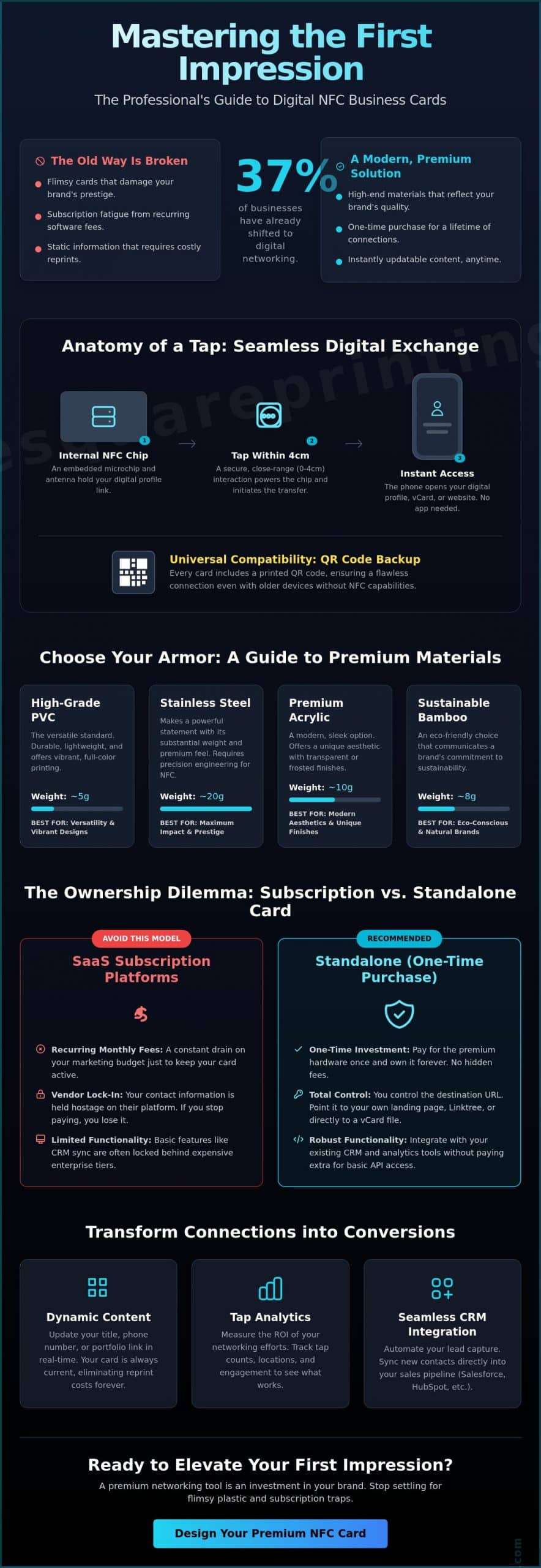
37% of businesses have already transitioned to digital networking, yet many professionals remain trapped in a cycle of subscription fatigue or embarrassed by flimsy plastic cards that fail during high-stakes meetings. You know that a first impression is a non-negotiable asset. It’s frustrating to invest in technology that either looks like a toy or demands a recurring monthly fee just to keep your contact info active. Digital NFC Business Cards should be a premium extension of your brand, not a technical liability or a constant overhead expense.
You deserve a networking tool that reflects your expertise through high-end materials and flawless performance. This guide will show you how to master the technical, aesthetic, and strategic aspects of NFC technology to elevate your professional presence. We’ll bridge the gap between sophisticated physical craftsmanship and the seamless digital integration required for modern lead tracking. We are diving into the latest IEC global standards, the shift toward durable materials like metal and bamboo, and the strategic ways to sync your card with your CRM without paying for basic functionality.
Key Takeaways
- Understand the underlying mechanics of Near Field Communication to ensure reliable, instant data transfers during every professional interaction.
- Evaluate the durability and brand prestige of various hardware materials, including high-grade PVC, stainless steel, and premium acrylic, to find your perfect match.
- Navigate the subscription landscape to select Digital NFC Business Cards that provide robust, standalone functionality without the burden of recurring monthly fees.
- Master design and UV printing techniques to balance visual hierarchy, ensuring your QR codes and brand aesthetics are perfectly calibrated for maximum impact.
- Leverage tap analytics and CRM integration to transform networking into a measurable marketing channel with clear ROI for trade shows and conventions.
What are Digital NFC Business Cards and How Do They Work?
The traditional exchange of paper business cards is rapidly becoming a relic of the past. As we move through 2026, professional networking has shifted toward a more efficient, tech-forward approach. Digital NFC Business Cards leverage a sophisticated communication protocol to share contact details, social links, and portfolios with a single physical interaction. Unlike their paper ancestors, these tools are dynamic. They allow for instant updates to your information without the need for a costly reprint.
The core of this technology is Near-Field Communication (NFC), which facilitates the seamless transfer of data between the card and a smartphone. When you tap your card against a mobile device, a tiny electromagnetic field powers the internal chip. This process triggers the phone to open a specific URL or download a contact file. It’s a frictionless experience that eliminates the need for manual data entry. By 2026, over 80% of smartphones are predicted to be NFC-ready, making this the universal language of professional exchange.
While the “tap” is the primary driver, a high-quality card always includes a QR code as a strategic fallback. This ensures that even older devices or those with NFC disabled can still access your information. This dual-layered approach guarantees that you never miss a connection during a high-stakes meeting. The recent adoption of global standards like IEC 63652-1:2026 has further solidified this technology. These standards ensure that your Digital NFC Business Cards work reliably across different manufacturers and regions.
NFC vs. Traditional RFID: Understanding the Tech
NFC is a short-range wireless technology that triggers actions on a receiver. While it shares roots with RFID, NFC operates on a specific 13.56 MHz frequency designed for secure, close-range interactions. It requires the card to be within 0 to 4cm of the smartphone. This limited range is a deliberate security feature. It prevents accidental data transfers and ensures that information is only shared when you make an intentional physical gesture.
The Anatomy of a Digital Business Card
Every card contains an internal microchip and a copper or aluminum antenna loop. This hardware is incredibly thin, allowing it to be embedded into various premium materials. The data payload usually consists of a URL that points to a dynamic landing page, though some cards are programmed with a direct VCF file. To protect this delicate internal tech, we use durable outer materials such as high-grade PVC, brushed metal, or sustainable wood. These materials don’t just protect the chip; they provide a tactile sense of brand prestige that paper simply cannot match.
Material Science: Choosing the Right Hardware for Your Brand
A premium business card serves as a tactile handshake. While the digital aspect is revolutionary, the physical substrate communicates your brand’s weight and stability before the first tap even occurs. High-performance Digital NFC Business Cards must balance aesthetic prestige with technical transparency. Selecting the right material isn’t merely a design choice; it’s an engineering decision that affects chip longevity and signal reliability.
Metal cards present a specific challenge known as the signal gap. Because stainless steel and aluminum act as electromagnetic shields, they naturally block the radio frequency signals required for data transfer. To solve this, master craftsmen utilize precision-milled cutouts or non-metallic windows that allow the antenna to breathe. This technical nuance aligns with the FCC explanation of NFC operational standards, which require specific proximity and clear paths for short-range communication. Without these engineered gaps, a metal card is just a heavy piece of jewelry that fails during a high-stakes meeting.
Weight influences perception. A standard PVC card weighs approximately 5 grams, while a stainless steel variant often reaches 20 grams. This physical heft creates an immediate sense of importance during an exchange. It signals that your professional brand is built on a foundation of quality and durability. If you’re ready to upgrade your networking hardware, exploring our range of Digital NFC Business Cards is the first step toward a more impactful first impression.
Custom PVC and Styrene: The Versatile Standard
PVC remains the industry standard for a reason. Its polymer surface allows for high-resolution, full-bleed printing that captures every detail of your brand’s color palette. It’s an exceptionally cost-effective solution for large team deployments where consistency is paramount. This material shares a natural synergy with professional PVC and Styrene signs, allowing your firm to maintain a unified visual identity across all physical touchpoints, from office signage to the cards in your pocket.
Premium Metal and Acrylic Options
For those seeking a bolder statement, metal and acrylic offer unparalleled durability and scratch resistance. Laser etching on stainless steel provides a permanent, sophisticated mark that won’t fade over time. Acrylic options allow for a unique depth of field and transparency, achieving an architectural feel that mirrors the quality standards of high-end acrylic photo prints. This one-time investment in hardware pays off by eliminating the need for recurring paper orders while ensuring your card remains pristine after years of use.
The Subscription Debate: SaaS Platforms vs. Standalone Cards
Subscription fatigue is a genuine challenge in the modern professional tech stack. Many providers of Digital NFC Business Cards anchor their value proposition to a Software-as-a-Service (SaaS) model, requiring monthly fees to keep your profile active. While these platforms offer polished interfaces, it’s vital to determine if you’re paying for essential utility or simply a branded landing page you could host yourself. The choice between a managed platform and a standalone card often dictates who truly owns your networking data.
Standalone cards offer a path to total digital independence. By programming your card to point toward a personal website, a LinkedIn profile, or a curated Linktree, you bypass recurring costs entirely. This “write-once” approach ensures your hardware remains functional as long as your destination URL exists. It eliminates the risk of “orphaned” cards, a common issue where a card becomes a useless piece of plastic because the SaaS provider went out of business or moved your features behind a higher paywall. For those prioritizing a high-end physical presence without ongoing overhead, our Digital NFC Business Cards provide the reliable hardware needed for either strategy.
Data ownership remains the most critical, yet overlooked, aspect of this debate. When you use a third-party platform, your contact interactions and lead lists are stored on their servers. A standalone framework keeps that data in your ecosystem. Before committing to a specific model, evaluate whether the “Pro” features like advanced tap analytics or custom CSS are worth the long-term investment or if a one-time hardware purchase meets your strategic needs.
Enterprise Features for Large Teams
For organizations managing 100 or more employees, the SaaS model often justifies its cost through centralized management. A master dashboard allows marketing directors to update job titles, brand assets, or promotional links across the entire fleet in real time. This ensures brand consistency without reprinting a single card. Integration with CRM systems like Salesforce or HubSpot allows for automated lead capture, turning every “tap” into a trackable entry in the sales funnel.
The Solo Professional Framework
Solo practitioners can maximize their ROI by choosing cards that support direct-to-VCF transfers or personal landing pages. A direct VCF (Virtual Contact File) payload triggers a “Create New Contact” prompt on the recipient’s phone instantly, removing the friction of an intermediate website. This method is fast, professional, and entirely free of subscriptions. It’s a results-oriented solution for experts who want their technology to work quietly in the background while they focus on closing deals.
Designing Digital Business Cards for Maximum Impact
Designing Digital NFC Business Cards is a sophisticated exercise in balancing high-performance technology with premium brand aesthetics. Unlike traditional stationery, the design must guide the recipient through two distinct experiences: the physical exchange and the digital landing. Achieving a visual hierarchy that highlights your logo while keeping the QR code accessible is vital. A cluttered card dilutes your authority. A minimalist approach ensures that the focus remains on your brand identity and the “tap” action.
Color calibration is where many generic designs fail. UV printing on substrates like brushed metal or acrylic requires precise adjustments to ensure brand colors remain vibrant and accurate across non-paper surfaces. This level of detail ensures that your networking tools maintain a consistent visual language across all marketing assets, from the retractable banners at your trade show booth to the card in your pocket. This cohesion signals to high-stakes clients that your operation is professional, meticulous, and reliable.
If you are ready to transition to a more permanent networking solution, you can customize your own Digital Business Cards to match your exact brand specifications and color profiles.
Technical Design Requirements
Precision is mandatory when working with die-cut materials. You must account for bleed zones and safe areas to prevent critical design elements from being clipped during the manufacturing process. Vector graphics are the gold standard for logos because they maintain perfect clarity at any scale, whereas raster images often pixelate on small surfaces. A resolution of at least 300 DPI is the minimum requirement for crisp, professional text on digital business cards. This technical threshold prevents the “muddy” look that characterizes low-quality alternatives.
Digital Profile Optimization
The physical card is the gateway, but the digital profile is the destination where the conversion happens. Adhering to the “Three-Second Rule” is essential. Your mobile landing page must communicate your value proposition almost instantly. Place your primary Call-to-Action (CTA), such as “Save Contact” or “Book a Meeting,” within the natural thumb-reach zone of the smartphone screen. Integrating social proof, including links to your portfolio or client reviews, reinforces your credibility the moment the data is shared. By optimizing both the physical and digital touchpoints, you transform a simple contact exchange into a high-impact marketing event.
Integrating NFC into Your 2026 Marketing Strategy
In the high-stakes environment of a 2026 convention, your networking tool must perform as a high-speed data conduit. Digital NFC Business Cards are no longer just standalone accessories; they are the connective tissue of a comprehensive physical marketing strategy. When you integrate these cards into your broader booth ecosystem, you bridge the gap between static environmental graphics and personal mobile devices. This hybrid approach transforms every interaction from a fleeting moment into a trackable, digital-first relationship that persists long after the event ends.
The future of this technology lies in its expansion into smart posters and interactive wall graphics. By embedding NFC tags into your large-format prints, you allow attendees to download brochures, view price lists, or register for demos with a simple tap against the wall. This turns your entire trade show displays setup into an interactive lead-generation machine. It’s a sophisticated way to manage booth traffic while ensuring that your brand’s digital footprint is as impactful as its physical presence.
Trade Show Lead Generation
Automation is the primary advantage of using NFC in a crowded convention hall. A single tap can trigger an immediate follow-up email or SMS through your CRM, ensuring you reach a prospect while your conversation is still fresh. This eliminates the manual labor of scanning paper cards or typing in email addresses at the end of a long day. You also significantly reduce paper waste and the associated shipping costs for heavy event collateral. For a truly tech-forward presence, coordinate your card’s visual identity with your electric retractable banners. This creates a unified, professional aesthetic that signals reliability and modern expertise to every passerby.
The ROI of Going Digital
Measuring the success of a networking event requires hard data, not just a stack of paper. Digital platforms allow you to calculate your cost-per-lead with precision by tracking tap analytics in real time. Companies transitioning away from traditional paper report a 90% cost reduction over the long term, according to verified industry data. Beyond the financial savings, there is a 30% higher follow-up rate associated with these tools because the data is transferred instantly and accurately. The sustainability of a single, permanent card also aligns with corporate environmental goals, removing the need for recurring print runs of thousands of paper cards. If you’re ready to secure your place in the future of networking, the next step is to order your digital business cards today and start measuring your true networking ROI.
Secure Your Competitive Edge with Precision Networking
Mastering the mechanics and material science of your networking tools is the definitive way to ensure your brand remains memorable in a fast-paced market. You now understand that the right hardware choice prevents technical failure during critical meetings, while a strategic digital destination secures your long-term data ownership. Digital NFC Business Cards represent a significant shift from passive contact sharing to active, measurable lead generation that integrates seamlessly with your broader 2026 marketing strategy. By choosing a standalone framework, you eliminate subscription fatigue and maintain total control over your professional identity.
Transitioning to this high-performance medium requires a collaborative partner who understands the intersection of technical precision and visual prestige. We offer professional design support and high-resolution UV printing on durable premium materials to ensure your first impression is always authoritative. Our commitment to quality and rapid delivery reflects the demanding standards of modern business. It’s time to retire fragile paper and embrace a permanent, tech-forward solution crafted for immediate results.
Ready to elevate your presence? Order Your Custom Digital NFC Business Cards and take command of your professional brand today. Your next high-stakes connection is just one tap away.
Frequently Asked Questions
Do digital NFC business cards require a specific app to work?
No, your recipients don’t need a specific app to receive your information. Most modern smartphones have built-in NFC readers that activate automatically when the card is in proximity. The device simply reads the data payload, such as a URL or contact file, and opens it using the native browser or contacts app. This frictionless exchange ensures your Digital NFC Business Cards work instantly without forcing your new connection to download software.
Are NFC business cards compatible with both iPhone and Android?
Yes, these cards are compatible with both iPhone and Android ecosystems. For Apple users, iPhone 7 and newer models support NFC reading, while most Android devices manufactured after 2012 include this technology as a standard feature. By 2026, it’s predicted that over 80% of smartphones globally will be NFC-ready. This universal compatibility makes the technology a reliable standard for professional networking across all major mobile platforms.
Can I update my contact information after the card is printed?
You can update your contact information instantly if your card is programmed with a dynamic URL. Because the physical card points to a digital landing page or a cloud-based profile, you simply change the details in your dashboard without reprinting the hardware. This flexibility is a primary advantage over traditional paper cards. It allows you to pivot your marketing strategy or update your job title in real time while keeping the same premium card.
Is there a monthly fee for using an NFC business card?
Monthly fees aren’t a technical requirement for Digital NFC Business Cards to function. While many SaaS platforms charge a subscription for advanced analytics and CRM integration, standalone cards can point directly to your website or a free profile. You have the choice to make a one-time hardware purchase or opt for a managed service. Selecting a standalone model ensures your card remains functional forever without any recurring overhead costs.
How long does the battery last in an NFC business card?
NFC business cards don’t have a battery and never require charging. They utilize passive induction technology, drawing a tiny amount of power from the smartphone’s electromagnetic field during the tap. This means the internal chip remains dormant until it’s within 0 to 4cm of a receiver. Your card will continue to function for years without power maintenance, provided the internal antenna and microchip remain physically intact.
Is my data secure when using a “Tap to Share” card?
Your data is highly secure because NFC requires intentional, close-range proximity to trigger a transfer. The extremely short operating range of 0 to 4cm prevents skimming or accidental data theft from a distance. Additionally, you control exactly what information is shared through your digital profile. You can even use password protection or encrypted links if you’re sharing sensitive portfolios or high-stakes project details during a meeting.
Can I have a QR code and NFC on the same card?
Combining a QR code and an NFC chip on the same card is a strategic best practice. This dual-layered approach provides a universal fallback for older devices or users who don’t have NFC enabled. While the chip offers a premium, high-tech experience, the QR code ensures 100% compatibility in any environment. It also serves as a visual cue, signaling to your contact that the card contains digital information.
What happens if the NFC chip gets wet or damaged?
The durability of your card depends on the protective outer material you choose. High-grade PVC and premium acrylic cards are completely waterproof, protecting the internal microchip from moisture and spills. While the chips are resilient, severe physical damage like deep bending can break the internal antenna loop. Choosing a durable substrate like stainless steel or reinforced polymer ensures your card survives the rigors of daily professional use.


